
Last updated September 16, 2026
The Complete Guide to Insulation in Palmdale
Palmdale sits in Climate Zone 15, one of the most thermally aggressive zones in California. Summer days routinely push past 100°F while winter nights drop below freezing, and the daily temperature swing often exceeds 40 degrees. Yet most homes in Palmdale were built to minimum code from the 1980s and 1990s, which means the average household here pays for that gap every single month in higher bills and uneven comfort. This guide walks through what actually works in this specific climate, what does not, and where your insulation dollars return the most, and you can find more guides & resources on our blog.
Quick Answer
For most Palmdale homes, the highest-impact insulation upgrade is attic air sealing combined with blown-in insulation at R-38 to R-49, followed by a radiant barrier to block summer heat gain. Attic work typically costs $2,800-$6,500 in Palmdale depending on square footage and access, and most of our jobs finish in a single visit; see our Insulation Cost Breakdown: The Palmdale Homeowner’s Reference for 2026 for full details. Wall and crawl space work matters, but the attic is where Palmdale homes lose and gain the most heat.
Table of Contents
- Why Palmdale’s Climate Demands Different Insulation Than Coastal California
- Why the Attic Comes First: The Order of Operations for Palmdale Homes
- Which Insulation Types Perform Best in Palmdale’s Climate
- Air Sealing: The Step Most Palmdale Contractors Skip
- Crawl Space and Slab-on-Grade Considerations for Palmdale Soils
- SCE and SoCalGas Rebates Plus Federal Tax Credits for Palmdale in 2025-2026
- What Insulation Costs in Palmdale: Real Numbers
- Common Mistakes to Avoid
- When to Call a Professional
- Frequently Asked Questions
- The Bottom Line
Why Palmdale’s Climate Demands Different Insulation Than Coastal California
Most generic insulation advice written for California assumes a mediterranean coastal climate: mild temperatures, high humidity, and a narrow daily range. Palmdale is none of those things. The city sits at roughly 2,600 feet of elevation in the Antelope Valley, which means dry air, intense solar radiation, and diurnal temperature swings that routinely exceed 40°F between 6 a.m. and 3 p.m. Insulation that works beautifully in Long Beach underperforms here because the physics are different.
The daily swing matters more than most homeowners realize. When outdoor temperatures climb to 105°F during the day and drop to 58°F at night, your home’s thermal envelope is stress-tested constantly. Insulation is not just about blocking heat; it’s about slowing the rate at which heat moves through the building shell. In Palmdale, that shell gets hammered from both directions within a single 24-hour period. A home with marginal attic insulation in Santa Monica is mildly uncomfortable. The same home in Palmdale is an oven by 2 p.m. and a refrigerator by 5 a.m.
Humidity, or the lack of it, also changes the calculation. Palmdale’s relative humidity often sits in the teens or low twenties, especially during Santa Ana wind events. Dry air conducts heat less efficiently than humid air, which is good news, but it also means conventional vapor barrier strategies designed for humid climates are often unnecessary or even counterproductive here. Homes in Palmdale rarely have moisture problems inside the wall cavity from vapor diffusion. They have dry heat problems, and the fix is different.
We have worked on homes across every Palmdale neighborhood, from Rancho Vista to Ana Verde to the older pockets near Palmdale Boulevard and 10th Street West. The pattern is consistent: homes built before the 2001 Title 24 update have attic insulation in the R-11 to R-19 range, when current recommendations for Climate Zone 15 sit at R-38 to R-49. That is a two- to four-fold shortfall in the single most important assembly in the house.
Why the Attic Comes First: The Order of Operations for Palmdale Homes
If you do one thing to your Palmdale home this year, insulate and air seal the attic. Not the walls. Not the floors. The attic. Here is why: in summer, attic surface temperatures in Palmdale regularly reach 140°F to 160°F. That heat radiates downward into your living space through the ceiling. In winter, the same attic becomes a cold zone that pulls heat out of your home through convection and radiation. Your ceiling is the largest single thermal boundary you have, and in a high-desert climate like Palmdale, it is where 40 to 50 percent of your total heat exchange happens.
The order of operations matters. We recommend this sequence for Palmdale homeowners:
- Start with a home energy audit. A blower door test and thermal imaging show exactly where your home leaks. This diagnostic step costs a few hundred dollars and prevents you from spending thousands on insulation that misses the real problem. Our audits in Palmdale routinely find top plate leaks and unsealed can lights that homeowners didn’t know existed.
- Air seal the attic floor before adding insulation. This is the step most contractors skip because it is tedious and invisible. More on this below, but understand: insulation slows heat transfer, while air sealing stops air movement. They are different problems. Skipping sealing before blowing insulation is like putting on a down jacket over a t-shirt with the zipper open.
- Bring attic insulation to R-38 minimum, R-49 preferred. For Palmdale, we typically install blown-in fiberglass or cellulose to R-49. The additional cost over R-38 is small, and the summer difference is measurable.
- Add a radiant barrier to the underside of the roof deck. This reflects radiant heat before it ever reaches the insulation. In Palmdale’s solar load, a radiant barrier can reduce attic temperatures by 15 to 25 degrees on a 105°F day.
- Address walls and crawl space only after the attic is done. Wall insulation in Palmdale’s older homes is a retrofit project that requires drilling and filling each stud bay. It helps, but it is a distant second to attic work for cost-effectiveness.
We’ve seen homes in Palmdale drop summer cooling costs by 30 to 40 percent after proper attic air sealing and blown-in insulation alone. That’s not marketing math; that’s what our customers report when they compare bills year over year. The Attic Insulation in Palmdale work is the foundation everything else builds on.
Which Insulation Types Perform Best in Palmdale’s Climate
Not every insulation product earns its keep in Palmdale. Here is how the major types stack up for this specific climate, based on 15 years of working in Antelope Valley homes.
Blown-In Fiberglass (Recommended for Most Attics)
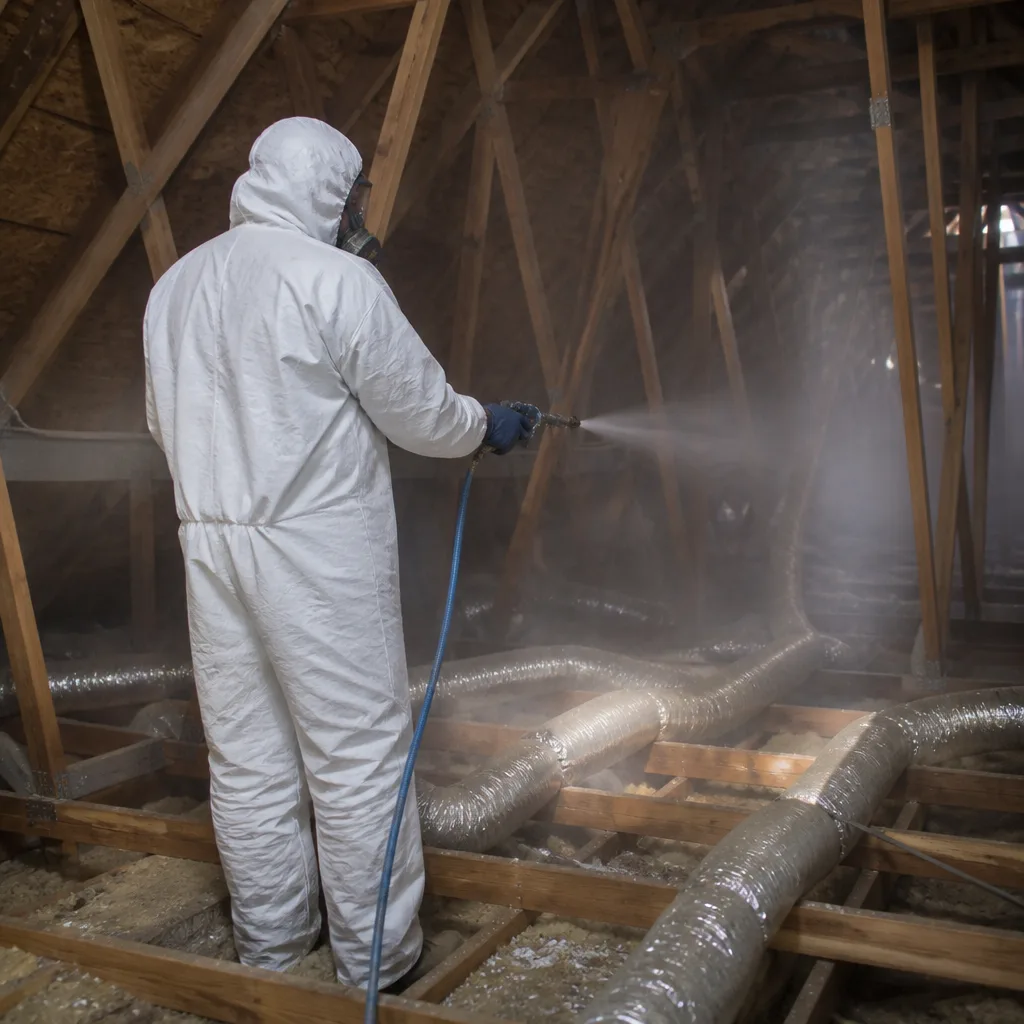
Blown-in fiberglass is our default recommendation for Palmdale attics. It settles evenly around joists and existing framing, it is cost-effective to bring up to R-49, and it does not hold moisture in a climate where moisture is rarely a problem anyway. Material partners like Knauf and Owens Corning produce blown-in fiberglass that delivers consistent thermal performance decade after decade. For older Palmdale homes with existing insulation, we often blow directly over the top after air sealing, which saves on removal costs. Learn more about our Blown-In Insulation in Palmdale service.
Cellulose (Best for Air Leak Retardation)
Cellulose insulation, typically made from recycled paper treated with fire retardant, offers slightly better air leak retardation than fiberglass. In Palmdale’s Santa Ana wind conditions, that matters because wind-driven air infiltration through attic penetrations is a real phenomenon. GreenFiber cellulose is one material we use for dense-pack wall applications and for attics where the homeowner wants maximum coverage. The trade-off is weight: cellulose is heavier than fiberglass, so we verify ceiling framing can handle the load before installation.
Spray Foam (Best for Hard-to-Reach Areas and Air Sealing)
Closed-cell spray foam is the premium option, and in Palmdale it earns its cost in specific applications: cathedral ceilings, bonus rooms over garages, and rim joists. It insulates and air seals in one step, which is why we recommend it for Palmdale homes with vaulted ceilings that cannot accommodate blown-in material. The cost is higher, typically two to three times blown-in per square foot, but the performance per inch is roughly double. For homes with conventional vented attics, spray foam is usually overkill unless the attic is being converted to conditioned space. See Spray Foam Insulation in Palmdale for details.
Radiant Barrier (High Value in Palmdale’s Solar Load)
Radiant barrier is a reflective foil installed on the underside of the roof rafters. It does not have an R-value in the traditional sense; it works by reflecting radiant heat rather than absorbing it. In Palmdale’s climate, with 300-plus sunny days per year, radiant barrier is one of the highest-value upgrades available. It is particularly effective on west- and south-facing roof planes, which take the harshest afternoon sun. We recommend it as a supplement to attic insulation, not a replacement.
What About Batts?
Fiberglass batts have their place in new construction, but for retrofitting Palmdale homes, they underperform. Batts leave gaps at joists, wiring, and plumbing penetrations, and those gaps allow air movement that undermines the insulation’s effectiveness. We generally recommend blown-in or spray foam for existing homes.
Air Sealing: The Step Most Palmdale Contractors Skip
Here is the uncomfortable truth about insulation in Palmdale: half the benefit of new attic insulation is thrown away if the attic floor is not air sealed first. Air sealing is the process of closing the gaps and penetrations where conditioned air escapes from your living space into the attic and where hot or cold attic air is pulled into the house. The top plate is the biggest offender.
The top plate is the horizontal framing member that sits on top of your wall studs. In almost every Palmdale home built before 2010, there is a gap where the drywall meets the top plate, often hidden behind framing or existing insulation. Air from your living space rises through wall cavities, hits the top plate gap, and pours into the attic. In winter, that is heated air you paid for. In summer, that is cool air your air conditioner worked to produce.
Other common leak points we find in Palmdale homes include:
- Recessed can lights that are not IC-rated and air sealed
- Bathroom exhaust fan housings vented into the attic instead of through the roof
- Attic hatches with no weatherstripping or insulation
- Plumbing and electrical penetrations through the top plate
- Chimney and flue chases with unsealed framing gaps
- Duct boots that are not sealed to the drywall
Ductwork deserves special mention in Palmdale. Many homes here have ducts in the attic, where they sit in 140°F summer heat. If those ducts leak, your air conditioner is fighting a losing battle: cooled air escapes into the attic while hot attic air gets sucked into the return side. Duct sealing and, where possible, burying ducts under insulation are two of the most cost-effective improvements available to Palmdale homeowners. When we do an attic insulation job, we always inspect the ductwork first. Sealing ducts and adding insulation at the same time produces compounding savings.
Skipping air sealing before adding insulation is the single biggest mistake we see in Palmdale homes. Insulation slows heat transfer through conduction. It does almost nothing to stop air movement through a gap. If you blow R-49 over an attic floor riddled with top plate gaps, you’ve made a warmer winter and a cooler summer, but the air still moves. You’ve spent thousands to get maybe 50 percent of the benefit.
Crawl Space and Slab-on-Grade Considerations for Palmdale Soils
Palmdale’s housing stock splits between slab-on-grade foundations and raised floors over crawl spaces, and the insulation strategy differs significantly between the two.
Slab-on-Grade Homes
Most newer Palmdale homes, particularly in developments built since the 1990s in areas like West Palmdale and Anaverde, sit on concrete slabs. Slab-on-grade construction eliminates the crawl space entirely, which removes one source of air infiltration but creates a different issue: the slab acts as a thermal mass that absorbs heat during the day and releases it at night. In summer, a slab in direct sun through west-facing windows can keep radiating heat into the evening. The fix here is not insulation under the slab, which is impractical in an existing home, but rather perimeter insulation and, more importantly, managing solar gain through windows and walls. Wall insulation does more for slab homes than for crawl space homes.
Crawl Space Homes
Older Palmdale homes, particularly those built in the 1950s through 1980s near Old Town Palmdale and along the 14 Freeway corridor, often have raised floors with crawl spaces. Palmdale’s arid climate means crawl spaces here are generally dry, which is good news: mold is rarely an issue. The bad news is that the crawl space soil is still soil, and soil holds moisture that evaporates into the space. Add in the fact that many Palmdale crawl spaces are vented to outside air, and you have a recipe for cold floors in winter and a place where pests like rodents and ants set up shop.
The solution for Palmdale crawl spaces is encapsulation: a vapor barrier over the soil, sealed foundation vents, and insulation on the foundation walls rather than under the floor. This approach is different from the vented crawl space model that was standard for decades. Encapsulation turns the crawl space into a semi-conditioned zone, which stabilizes floor temperatures and reduces the stack effect that pulls air from the crawl space into the living area. We use Johns Manville and Knauf products for crawl space work, and we always include rodent proofing as part of the job. Palmdale has a healthy population of roof rats, and a crawl space with open vents and bare soil is an open invitation.
SCE and SoCalGas Rebates Plus Federal Tax Credits for Palmdale in 2025-2026
Palmdale homeowners have access to multiple incentive programs that can meaningfully reduce the cost of insulation upgrades. The landscape changed with the Inflation Reduction Act, and the current structure is friendlier to insulation work than at any point in the past decade.
Southern California Edison (SCE) Rebates
SCE serves Palmdale and offers rebates for energy efficiency improvements through its Energy Savings Assistance Program and the statewide Energy Upgrade California initiative. For insulation specifically, SCE rebates typically apply to attic insulation and duct sealing, with the rebate amount calculated based on the square footage of the upgrade and the R-value achieved. We help our Palmdale customers identify which programs apply and handle the paperwork, but the rebate is paid to the homeowner. As of 2025, the most direct path is through the Home Energy Renovation Opportunity (HERO) and Golden State Rebates programs, which offer point-of-sale rebates for qualifying insulation.
SoCalGas Rebates
SoCalGas also serves Palmdale and offers rebates through the Energy Savings Assistance Program for qualifying low-income households. For standard income households, the primary SoCalGas incentives for insulation and air sealing are available through the Energy Upgrade California Home Upgrade program, which bundles multiple improvements into a single rebate structure. A typical Palmdale home that combines attic insulation, duct sealing, and air sealing can qualify for $1,000 to $3,000 in combined utility rebates depending on the scope of work.
Federal Tax Credits
The Energy Efficient Home Improvement Credit, extended through 2032, provides a 30 percent federal tax credit for qualifying insulation and air sealing materials, up to $1,200 per year. This applies to insulation materials and systems that meet or exceed the International Energy Conservation Code. For Palmdale homeowners, the combination of a $1,200 federal credit and utility rebates can reduce the net cost of a $4,500 attic insulation project by $1,500 to $2,500. We always recommend checking with your tax preparer, but the insulation work itself is the qualifying expense.
These programs change periodically, and the paperwork requirements shift. We handle the documentation for every Palmdale job we do, and we’ll tell you upfront which incentives apply to your specific address. A home energy audit is the first step in documenting the before condition, which most rebate programs require.
What Insulation Costs in Palmdale: Real Numbers
Insulation pricing in Palmdale runs slightly below the Los Angeles Basin average because the market is more competitive and permit costs are lower, but material costs are the same. Here is what we quote for typical Palmdale homes as of 2025-2026:
| Service | Typical Palmdale Range | Notes |
|---|---|---|
| Attic air sealing + blown-in to R-49 (1,500 sq ft attic) | $3,200-$5,800 | Most common job we do; includes duct inspection |
| Attic insulation only (blown-in to R-49, no air sealing) | $1,800-$3,200 | Cheaper upfront; we do not recommend skipping sealing |
| Radiant barrier installation (1,500 sq ft roof deck) | $1,500-$2,800 | High value in Palmdale’s summer sun |
| Spray foam attic (closed-cell, 1,000 sq ft) | $5,500-$9,000 | Best for cathedral ceilings or conditioned attics |
| Crawl space encapsulation (1,200 sq ft) | $4,000-$8,000 | Includes vapor barrier, sealing, and insulation |
| Wall insulation retrofit (2,000 sq ft home) | $4,500-$9,000 | Drill and fill; drill hole patching included |
| Home energy audit with blower door test | $250-$450 | Credited toward project cost if we do the work |
These numbers reflect what we see across Palmdale jobs in 2025 and 2026. Your specific cost depends on attic access, existing insulation depth, ductwork condition, and whether rodent remediation or cleaning is needed first. We give upfront pricing before starting, and the quote does not change unless scope changes. Palmdale homes with vaulted ceilings or converted attics push toward the higher end of these ranges. Seniors and veterans receive a permanent 5 percent discount on all work, and we currently offer $50 off any repair over $250 and an $89 seasonal tune-up for existing customers.
Common Mistakes to Avoid
- Adding insulation without air sealing first. This is the number one mistake in Palmdale. Blowing new insulation over an unsealed attic floor locks in the leaks and makes them harder to find later. Air seal first, always.
- Using R-38 when R-49 costs marginally more. The incremental cost of going from R-38 to R-49 on a typical Palmdale attic is $400 to $800. The thermal benefit compounds every summer and winter for the life of the home. Skip the upgrade and you leave money on the table.
- Choosing batt insulation for a retrofit. Batts leave gaps around framing and penetrations, and those gaps allow air movement. Palmdale’s temperature swings punish gaps relentlessly. Blown-in or spray foam is the correct call for existing homes.
- Ignoring the ductwork in the attic. If your ducts leak, your insulation is doing half its job at best. Palmdale attics hit 140°F in summer; leaky ducts in that environment cost more than any insulation R-value can recover.
- Assuming crawl space vents are necessary. Decades of building code told Palmdale builders to vent crawl spaces. That advice was written for humid climates, not the high desert. Encapsulated crawl spaces outperform vented ones in Palmdale’s dry conditions.
- Skipping the home energy audit because “we know where the problem is.” Almost every Palmdale homeowner who skips the audit ends up paying for work that does not solve the problem. A blower door test costs a few hundred dollars and tells you exactly where your home leaks. Guesswork costs thousands.
- Waiting until summer to schedule the work. Palmdale insulation contractors are busiest from May through September. Schedule in the fall or winter and you’ll get better pricing, better availability, and a more comfortable home before the next heat wave.
When to Call a Professional
Insulation work in California requires a C-2 license, and the work itself involves working in confined attic spaces, handling fiberglass and spray foam chemicals, and navigating electrical and framing hazards. Some things in a home are DIY-friendly. Attic insulation in Palmdale is not one of them. If your attic has existing insulation that may contain vermiculite or rodent droppings, if you have vaulted ceilings, or if your home is older than 1990 and has never been air sealed, call a professional. The cost of a mistake over your head is higher than the cost of doing it right the first time.
Warmline Insulation Co. offers free estimates in Palmdale. Call (661) 613-2043 and a live person answers, 24 hours a day. No voicemail, no answering service. We’ll schedule a walkthrough, give you upfront pricing, and most jobs are done in a single visit.
Frequently Asked Questions
Attic insulation in Palmdale typically costs $1,800 to $5,800 depending on attic size, the R-value target, and whether air sealing is included. Most Palmdale homes fall in the $3,200 to $5,800 range for a complete air sealing plus blown-in fiberglass job to R-49. Call (661) 613-2043 for a free estimate on your specific home, and ask about the $50 off any repair over $250 offer.
Palmdale’s Climate Zone 15 calls for R-38 to R-49 in attics, and we recommend R-49 for any attic that receives direct summer sun. The additional cost over R-38 is small, and the year-round benefit in Palmdale’s extreme temperature swings justifies the upgrade.
Most attic insulation and air sealing jobs in Palmdale are completed in a single visit. Larger projects involving crawl space encapsulation, wall insulation, or spray foam may take two to three days. We schedule upfront and the timeline does not surprise you later.
Insulation work without structural changes generally does not require a city permit in Palmdale, though the work must be performed by a licensed C-2 contractor. Some crawl space encapsulation projects that involve structural repairs may need a permit, and we handle that process when it applies.
The material cost is the same year round, but scheduling is easier in the fall and winter when Palmdale insulation contractors are less busy. You may also find seasonal offers; we run the $89 tune-up special year-round for existing customers.
In most Palmdale homes, hot upstairs rooms are caused by attic heat gain combined with air leaks and poorly insulated ducts. Proper attic air sealing, blown-in insulation to R-49, and a radiant barrier typically reduce upstairs temperatures significantly, often by 10 degrees or more during peak summer days.
The Bottom Line
Palmdale’s high-desert climate punishes homes built to outdated code assumptions, and the attic is where most of the punishment lands. The highest-value sequence of work is air sealing first, then blown-in insulation to R-49, then a radiant barrier, then ducts. Utility rebates and federal tax credits reduce the net cost substantially. And the single most important decision you can make is hiring a contractor who understands Palmdale specifically, not California generically-our How to Hire a Insulation Contractor in Palmdale: A Step-by-Step Guide walks you through exactly what to look for. Warmline Insulation Co. has been serving Palmdale since 2011, and every job is backed by our 90-Day Done Right Promise. If it is not done right, we make it right.
Written by Neil Ashford, Owner at Warmline Insulation Co., serving Palmdale since 2011.