
Last updated September 16, 2026
Insulation Cost Breakdown: The Palmdale Homeowner’s Reference for 2026
The cheapest attic insulation quote you’ll get in Palmdale almost always excludes three things: attic air sealing, debris removal, and the compliance certificate. Add those back in and it’s rarely the best deal. What looks like a bargain on paper often costs more within three years, because the house is still leaking conditioned air through bypasses the cut-rate contractor never touched. This guide breaks down what actually drives insulation costs in Palmdale in 2026, line item by line item, so you can compare quotes with a level of clarity most homeowners never get.
Quick Answer
Insulation costs in Palmdale in 2026 run from about $1.50 to $3.50 per square foot for attic blown-in fiberglass, $3.50 to $7.00 per square foot for spray foam, and $4.00 to $9.00 per square foot for crawl space encapsulation. A typical 1,500-square-foot attic insulation job lands between $2,250 and $5,250 before incentives. The federal 25C tax credit covers 30% of material costs up to $1,200 per year, and SCE and SoCalGas rebates can knock off another few hundred dollars depending on the project type.
Table of Contents
- 2026 Palmdale Price Ranges by Project Type
- The Hidden Cost Variables That Move a Quote Up or Down
- How to Calculate Your Actual Payback Period Using Palmdale Rates
- Federal Tax Credits and SoCal Utility Rebates: Your Real Net Cost
- Why R-30 Is Almost Never the Cheapest Over 10 Years
- Materials Breakdown: What Each Brand Actually Costs
- Why Insulation Installation Speed Matters More Than You Think
- Common Mistakes to Avoid
- When to Call a Professional
- Frequently Asked Questions
- The Bottom Line
Before we dig into the numbers, a note on how this guide is built. The figures below reflect what we at Warmline Insulation Co. home see in the Palmdale market as of early 2026. They’re informed by 15 years of quoting and completing jobs across Lancaster, Quartz Hill, Leona Valley, and every neighborhood in between. We’ll show you exactly where money goes on an insulation quote, and where it shouldn’t.
2026 Palmdale Price Ranges by Project Type
Insulation pricing in Palmdale is not a mystery. It’s a function of material type, application method, square footage, and access difficulty. Here are the realistic ranges we’re seeing across the Antelope Valley this year, with enough specificity that you can hold any quote up against them.
Attic Blown-In Insulation: $1.50 to $3.50 per square foot
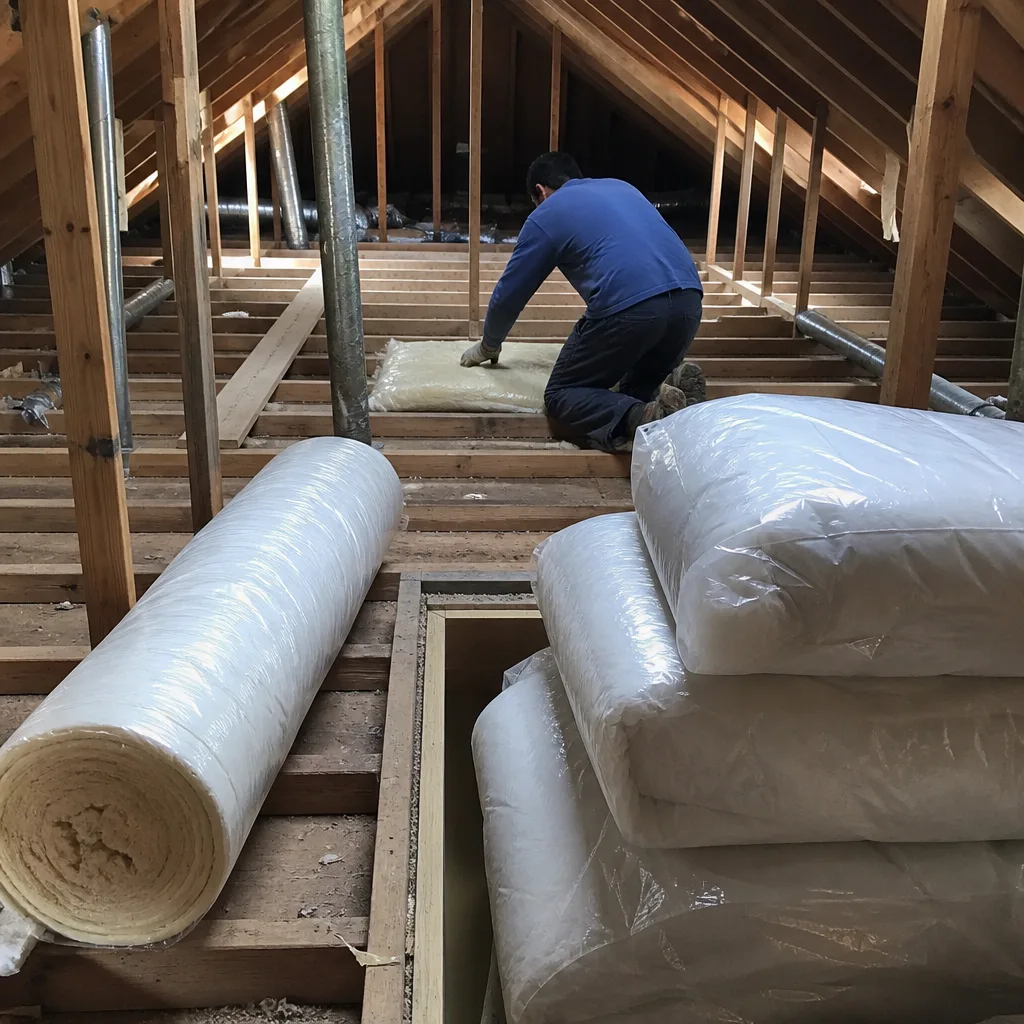
Blown-in fiberglass or cellulose is the workhorse of Palmdale attics. For a standard 1,500-square-foot attic with existing insulation that needs topping off to R-38, expect $2,250 to $5,250 total. If the attic has old, settled, or contaminated insulation that needs removal first, add $1.00 to $2.00 per square foot for the removal and disposal. We’ll cover why removal costs what it does in the section on hidden variables.
Attic Batt Replacement: $2.00 to $4.00 per square foot
Fiberglass batt replacement costs more than blown-in because it’s more labor-intensive. Each batt has to be cut, fit, and layered. In Palmdale’s older housing stock, a lot of attics from the 1980s and 1990s have R-19 batts that were installed incorrectly the first time. Replacing them properly with R-38 or R-49 batts typically runs $3,000 to $6,000 for a standard attic. More on our approach to Attic Insulation in Palmdale here.
Spray Foam Rim Joist and Attic: $3.50 to $7.00 per square foot
Closed-cell spray foam costs more per square foot than any other insulation type, but it delivers air sealing and insulation in one step. For rim joists, a common Palmdale upgrade, expect $3.50 to $5.50 per lineal foot treated. Full attic spray foam on the roofline runs $5.00 to $7.00 per square foot. The material cost is higher because it’s a chemically manufactured product, not a spun fiber, and the installation requires specialized equipment and certified technicians. Brands like Icynene and Demilec dominate this space, and the pricing you’ll see from qualified installers reflects the material quality. We detail Spray Foam Insulation in Palmdale pricing factors in that guide.
Crawl Space Encapsulation: $4.00 to $9.00 per square foot
Encapsulation is a different animal from insulation alone. It involves a vapor barrier, sealing of vents and penetrations, insulation of the crawl space walls, and often a dehumidifier. In Palmdale, where the desert climate keeps the ground dry most of the year but the winter months bring real moisture, encapsulation protects both the subfloor and the home’s air quality. A 1,000-square-foot crawl space runs $4,000 to $9,000 depending on condition, access, and whether rodent proofing is needed.
Wall Injection (Drill and Fill): $1.75 to $3.25 per square foot
For existing homes with empty wall cavities, injecting blown-in fiberglass or cellulose through small drill holes is the least invasive retrofit option. In Palmdale’s stucco-heavy housing stock, this often means drilling through the exterior and patching afterward. Expect $1.75 to $3.25 per square foot of wall area, plus $75 to $150 per hole for patching if it’s not included in the quote.
Quick reference table:
- Attic blown-in: $1.50-$3.50/sq ft
- Attic batt replacement: $2.00-$4.00/sq ft
- Spray foam rim joist: $3.50-$5.50/lineal ft
- Spray foam attic roofline: $5.00-$7.00/sq ft
- Crawl space encapsulation: $4.00-$9.00/sq ft
- Wall injection: $1.75-$3.25/sq ft
The Hidden Cost Variables That Move a Quote Up or Down
Two Palmdale houses with identical square footage can have insulation quotes that differ by 40 to 60 percent. Here’s what’s actually creating that spread and whether each variable is a legitimate cost or a red flag.
1. Attic Height Clearance and Access
A standard attic with a ceiling height of 4 to 5 feet allows a technician to move fairly normally. A low-slope roof with 18 inches of clearance means crawling on belly boards, working with headlamps, and taking three times as long to achieve the same coverage. If your Palmdale home has a low-pitch roof, a legitimate quote will reflect the added labor. If a contractor quotes the same price as a neighbor with a spacious attic, they’re either absorbing the cost or cutting corners.
2. Existing Insulation Removal
Old fiberglass that’s been compressed by decades of dust storms, or cellulose that’s been contaminated by rodent activity, can’t simply be covered with new insulation. It has to come out. Removal and disposal runs $1.00 to $2.00 per square foot in Palmdale, and includes bagging, vacuuming, and hauling to a licensed disposal facility. Cut-rate quotes often skip this step entirely, laying new insulation over old contamination, which is a building-science failure and a health issue.
3. HERS Testing Requirements
California’s Title 24 building code requires HERS (Home Energy Rating System) verification on certain insulation projects, especially when permitted through LA County. A HERS rater independently verifies that the insulation was installed to the stated R-value and coverage. Testing typically costs $250 to $500, and a compliant contractor will have this line item spelled out. A quote that’s suspiciously low may be omitting the HERS test, which means no compliance certificate, which means trouble if you ever sell the house.
4. LA County Permit Fees
Not every insulation job requires a permit, but attic insulation that includes air sealing or structural changes often does. LA County permit fees for insulation work in the Palmdale area typically run $150 to $400 depending on scope. Some contractors include this in their quote, some add it as a separate line. Either way, it should appear somewhere. If it doesn’t, ask why.
5. The Condition of Your Ductwork
Here’s a variable that surprises Palmdale homeowners every year. In many homes built before 2000, the ductwork in the attic is leaking 15 to 25 percent of conditioned air. We see it constantly. If your ducts are in rough shape, adding insulation without addressing the duct leaks is like putting a lid on a pot with holes in the side. A good insulation contractor will flag this during the attic inspection. It adds cost, but it’s the cost that makes the insulation actually work.
How to Calculate Your Actual Payback Period Using Palmdale Rates
The national-average payback calculators you find online are almost useless for Palmdale. They use national average utility rates and generic climate data. Here’s how to calculate your real payback period using the numbers that apply to your house.
Step 1: Find your actual cooling cost. Southern California Edison’s residential rates in Palmdale as of January 2026 are roughly $0.32 to $0.38 per kilowatt-hour during peak summer hours, depending on your rate plan. Pull your July and August bills from last year and look at the total kWh you used. The cooling portion of that is typically 50 to 60 percent of the total electricity load in Palmdale’s summer months, because air conditioning is the single biggest draw in a desert climate.
Step 2: Estimate your cooling load reduction. Proper attic insulation from R-19 to R-38 or R-49 typically cuts cooling energy use by 15 to 25 percent in Climate Zone 15, which is where Palmdale sits. Use 15 percent if your attic is already partially insulated, 25 percent if it’s nearly bare. Multiply your cooling kWh by that percentage. That’s your annual kWh savings from the upgrade.
Step 3: Multiply by your rate. Say your summer cooling uses 4,000 kWh. A 20 percent reduction saves 800 kWh. At $0.35 per kWh, that’s $280 per summer in avoided cost. Over the course of a full year, including a smaller heating benefit in Palmdale’s relatively mild winters, you’re looking at $350 to $450 in annual savings for a typical home.
Step 4: Divide the project cost by annual savings. A $3,500 attic insulation job that saves $400 per year pays back in 8.75 years. That’s the honest math in Palmdale. It’s not the 3-year payback some energy calculators claim, and it’s not the 15-year timeline skeptics assume. It lands in between, and it improves as SCE rates keep climbing, which they have done consistently for the past decade.
Step 5: Factor in comfort and equity. Payback math misses the value of a bedroom that’s actually comfortable in August, or a house that doesn’t smell like attic dust every time the AC kicks on. Those are real benefits, they just don’t fit neatly into a spreadsheet. And when you sell, a documented insulation upgrade with a compliance certificate is a line item on the disclosure that buyers in Palmdale increasingly ask about.
Federal Tax Credits and SoCal Utility Rebates: Your Real Net Cost
The sticker price on an insulation quote is not what you pay. Here’s the incentive picture for Palmdale homeowners in 2026.
Federal 25C Tax Credit
The federal Energy Efficient Home Improvement Credit, known as 25C, covers 30 percent of the material cost for qualifying insulation and air sealing products, up to a $1,200 annual maximum. That’s a tax credit, not a deduction. It reduces your tax bill dollar for dollar. For a $3,500 attic insulation job where materials cost $2,000, the credit is $600. The labor portion doesn’t qualify, which is why the credit is calculated on materials only. Your installer should provide an itemized invoice that separates materials from labor so you can claim the credit accurately.
SCE Rebates
Southern California Edison’s residential energy efficiency rebate program for 2026 includes insulation incentives that vary by project type. Attic insulation rebates through the SCE Home Energy Upgrade program typically run $0.15 to $0.25 per square foot when installed through a participating contractor. A 1,500-square-foot attic would qualify for $225 to $375. These rebates are often applied at the point of sale by the contractor, so the price you see already reflects the credit.
SoCalGas Rebates
For insulation projects tied to heating efficiency, SoCalGas offers rebates through the Energy Savings Assistance Program and the Home Upgrade program. Wall insulation and attic insulation that demonstrably reduces heating load may qualify for $0.10 to $0.20 per square foot. The actual amount depends on your home’s baseline and the specific measure installed.
Stacking example: a $3,500 attic insulation job in Palmdale with $2,000 in materials. Federal 25C credit: $600. SCE rebate: $300. Net cost after incentives: $2,600. That’s a 25 percent reduction off the sticker price, and it changes the payback math from 8.75 years to 6.5 years.
The incentives are real, but they require documentation. A contractor who provides proper invoices and compliance certificates makes the credits straightforward to claim. A contractor who hands you a handwritten receipt and no HERS certificate makes it nearly impossible, and that’s another hidden cost of the cheapest quote.
Why R-30 Is Almost Never the Cheapest Over 10 Years
Climate Zone 15, which includes all of Palmdale, has a California Title 24 minimum requirement of R-38 for attic insulation in new construction. Existing homes often have R-19 or less. A contractor who proposes R-30 is offering something that doesn’t meet current code, and here’s the thing: the difference in material cost between R-30 and R-49 is a few hundred dollars. The difference in energy performance compounds every year.
The 10-year comparison:
- R-30 attic insulation: installed cost roughly $2,500. Annual energy loss is higher, roughly 10 to 15 percent more cooling load than R-38. Ten-year energy cost premium: $800 to $1,200.
- R-38 attic insulation: installed cost roughly $3,000. Meets current code. Ten-year energy cost is the baseline.
- R-49 attic insulation: installed cost roughly $3,500. Annual energy cost is 5 to 8 percent lower than R-38. Ten-year energy savings: $400 to $700.
Over a decade, the R-49 option costs $500 more up front and saves $700 more in energy, making it $200 cheaper in total lifetime cost. And that’s before you factor in comfort, which is the thing you’ll notice every single day. In Palmdale’s summer heat, where attic temperatures routinely hit 140 degrees in July, the difference between R-38 and R-49 shows up as a house that holds its temperature longer and cycles the AC less frequently.
Material partners like Owens Corning and CertainTeed make both R-38 and R-49 blown-in fiberglass products. The step-up cost is incremental. The decision should not be. The lowest R-value proposal is almost never the lowest lifetime cost, and any contractor who leads with the cheapest R-value is optimizing for their closing rate, not your energy bill.
Materials Breakdown: What Each Brand Actually Costs
When a quote lists a material brand, it’s not marketing fluff. Different insulation products have different densities, fire ratings, and settling characteristics, and those differences show up in price.
Fiberglass blown-in (CertainTeed, Johns Manville): $0.60 to $1.10 per square foot for material. Expect some settling over the first year, which is why proper coverage calculations add 15 to 20 percent on top of the target depth.
Cellulose blown-in (GreenFiber): $0.50 to $0.90 per square foot for material. Made from recycled paper with a borate fire retardant. Slightly cheaper than fiberglass, slightly better at air-blocking, but heavier and can settle more if not dense-packed properly.
Closed-cell spray foam (Icynene, Demilec): $1.50 to $2.50 per board foot for material. Delivers R-6.5 to R-7 per inch, acts as an air and vapor barrier, and adds structural strength. The most expensive material, justified by the fact that it does the job of insulation and air sealing simultaneously.
Radiant barrier: $0.50 to $1.00 per square foot. A reflective foil that reduces radiant heat gain through the roof deck, which matters a lot in Palmdale’s high-solar-exposure summers. Best combined with conventional insulation, not as a replacement for it.
The material line on your quote should be specific. A quote that says “insulation” with no brand, no R-value, and no square footage is a placeholder, not a proposal. You deserve better, and the 25C tax credit requires better documentation anyway.
Why Insulation Installation Speed Matters More Than You Think
Most insulation jobs in Palmdale are completed in a single day. That’s not an accident of scheduling, it’s a signal of competence. Here’s why.
1. Attic work should be done before the heat arrives. A crew that starts at 7 a.m. in a Palmdale attic has maybe six hours before the space becomes dangerously hot in the summer months. The work needs to be planned, efficient, and complete. A contractor who needs multiple return visits for a standard attic job is either disorganized or understaffed.
2. Disruption compounds with time. A single-day job means one morning of trucks in the driveway and one afternoon of cleanup. A job stretched across three days means three mornings of disruption, and the homeowner is the one paying for it in their own daily rhythm.
3. The 90-Day Done Right Promise means the job has to be right the first time. Here’s where we put our own guarantee in writing. At Warmline Insulation Co., most jobs are completed in a single visit, and our 90-Day Done Right Promise kicks in afterward. If something isn’t right within 90 days of completion, we make it right. That’s not a verbal assurance, it’s a written commitment, and it’s the reason we plan every job before the crew arrives rather than figuring it out in your driveway.
4. Speed requires preparation. A contractor who completes a job in one day has likely done a pre-job inspection, ordered the right materials, and assigned the right crew size. A contractor who needs multiple visits may be figuring out the scope as they go. You don’t want to fund someone’s on-the-job training.
Common Mistakes to Avoid
- Comparing quotes by total price alone. A $2,500 quote and a $4,000 quote for the same attic often describe different jobs. The $2,500 one may be omitting air sealing, removal, or HERS testing. Compare line items, not bottom lines.
- Accepting R-30 in Climate Zone 15. R-30 doesn’t meet current California code for Palmdale, and the savings you get from a cheaper install evaporate within a few years of higher energy costs. Minimum R-38, preferably R-49.
- Skipping attic air sealing. Insulation slows heat transfer. Air sealing stops conditioned air from leaking out through plumbing penetrations, recessed lights, and top plates. Without air sealing, your insulation is doing half its job. In our experience across Palmdale attics, air sealing is the highest-leverage dollar you can spend.
- Not asking for a HERS certificate. The compliance certificate is your proof that the insulation is what the contractor said it was. If you sell your home, a buyer may ask. If you claim the 25C credit, the IRS may ask. Get it in writing.
- Ignoring rodent damage while insulating. Palmdale attics see more rodent activity than homeowners want to know about, especially in older neighborhoods near open desert. Insulating over contaminated or chewed-through material traps the problem. Address rodent proofing before or during the insulation job, not after.
- Assuming the cheapest material is fine. GreenFiber cellulose and CertainTeed fiberglass have different performance characteristics. The material choice should match the attic’s configuration, not the contractor’s default. Ask why they recommend the material they recommended.
- Not asking about the $89 Seasonal Tune-Up. After insulation is installed, an annual checkup catches settling, moisture issues, and pest entry before they become expensive repairs. We offer an $89 Seasonal Tune-Up specifically for this, and it’s the cheapest preventive maintenance most Palmdale homeowners can do for their attic.
When to Call a Professional
Insulation is not a DIY project. Attics are dangerous places in Palmdale summers, with surface temperatures that can exceed 130 degrees by late morning. Working in those conditions without proper gear and training is a real health risk. Beyond safety, the building science is unforgiving: improper depth, missed air leaks, and incorrect material placement all undermine the project’s value. If your attic has visible rodent activity, old or water-damaged insulation, or you’re planning to claim the federal 25C credit, get a professional involved. The documentation alone is worth the cost of labor. Warmline Insulation Co. offers free estimates in Palmdale covering the full scope of attic insulation, blown-in insulation, and spray foam insulation, with no obligation. Call (661) 613-2043 and a live person answers, 24/7.
Frequently Asked Questions
Attic insulation in Palmdale runs $1.50 to $3.50 per square foot for blown-in fiberglass or cellulose, meaning a typical 1,500-square-foot attic costs $2,250 to $5,250. If old insulation needs removal first, add $1.00 to $2.00 per square foot. Call (661) 613-2043 for a free, line-itemed quote specific to your attic.
Topping off existing insulation that’s in good condition is cheaper than full replacement, roughly $1.50 to $2.00 per square foot versus $2.50 to $3.50 for removal and new install. But if the existing insulation is compressed, water-damaged, or rodent-contaminated, replacement is the only option that actually works. A free estimate will tell you which path your attic needs.
Spray foam insulation in Palmdale averages $3.50 to $7.00 per square foot depending on application. Rim joist work runs $3.50 to $5.50 per lineal foot, while a full attic roofline application runs $5.00 to $7.00 per square foot. The higher cost reflects the material’s dual function as insulation and air barrier.
Many insulation projects in Palmdale require an LA County building permit, especially when air sealing or structural modifications are involved. Permit fees typically range from $150 to $400. A compliant contractor will include the permit line item in the quote, not surprise you with it later.
We schedule free estimates in Palmdale and across the Antelope Valley every business day. Call (661) 613-2043 and a live person answers 24/7, no voicemail. Most estimates are completed the same day or next day depending on your schedule.
The federal 25C credit covers 30 percent of material costs for qualifying insulation and air sealing, up to $1,200 per year. For a $3,500 attic job with $2,000 in materials, that’s a $600 credit. You’ll need an itemized invoice that separates materials from labor, which we provide on every job.
The Bottom Line
Insulation quotes in Palmdale vary by 40 to 60 percent because contractors are quoting different scopes of work, not the same scope at different prices. The cheapest quote usually omits air sealing, removal, or compliance documentation, and those omissions cost more in the long run than they save up front. Know your R-value requirements in Climate Zone 15, know what’s actually in your attic before you get quoted, and get everything in writing. If a quote feels vague, ask for line items. If a contractor won’t provide them, that’s your answer. If you want an honest, itemized estimate from a team that’s been serving Palmdale since 2011, call us at (661) 613-2043. The visit is free, the conversation is direct, and we’ll tell you exactly what your insulation should cost, and why.
Written by Neil Ashford, Owner at Warmline Insulation Co., serving Palmdale since 2011.