
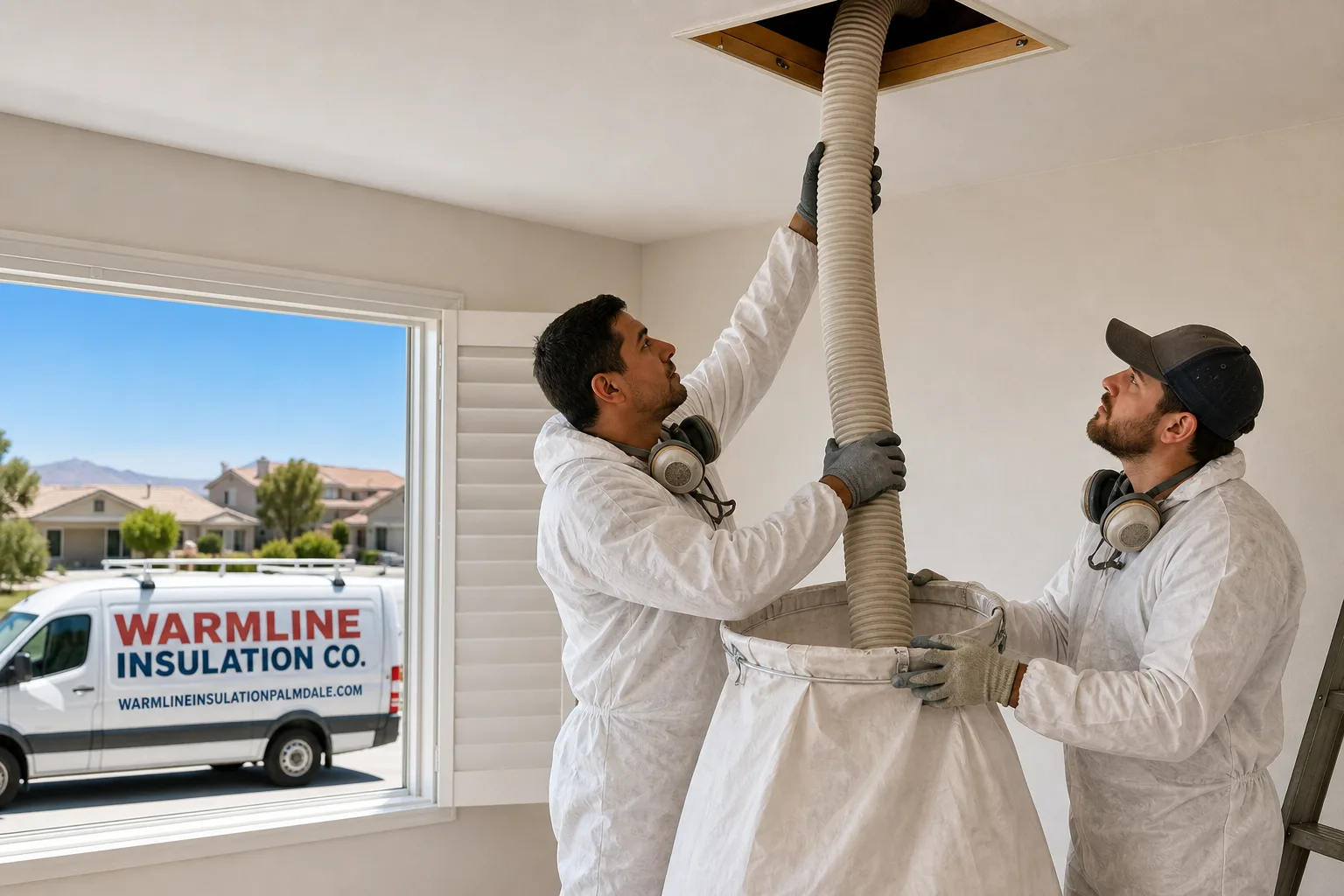
How Much Does Wall Insulation Cost in Palmdale?
Our Wall Insulation services in Palmdale, CA typically cost between $1.50 and $4.25 per square foot installed, with most single-family homes landing somewhere between $1,800 and $6,500 for a full-house project in 2026. Exact pricing depends on the insulation type, whether your walls are open (new construction or gut renovation) or closed (retrofit), and the total square footage of wall cavity space being treated.
If you want a number specific to your home, call (661) 613-2043 – a live person answers every call, and we’ll give you a free, upfront estimate, usually completable in a single visit.
Wall Insulation Cost Breakdown (2026)
The table below reflects real pricing in the Palmdale market. These are installed costs – meaning labor, materials, and cleanup are included. They are not material-only prices you’d find at a big-box store.
| Insulation Type | Best For | Cost Per Sq Ft (Installed) | Typical Whole-Home Cost |
|---|---|---|---|
| Blown-In Fiberglass (retrofit) | Closed existing walls | $1.80 – $2.60 | $2,200 – $4,000 |
| Blown-In Cellulose (retrofit) | Closed existing walls | $1.50 – $2.40 | $1,800 – $3,800 |
| Batts – Fiberglass (open walls) | New construction / gut remodel | $1.20 – $1.80 | $1,500 – $3,200 |
| Batts – Rockwool / Mineral Wool (open walls) | Fire-rated, noise-critical walls | $1.90 – $2.80 | $2,400 – $4,500 |
| Open-Cell Spray Foam (open walls) | Air sealing + insulating together | $2.50 – $3.50 | $3,200 – $5,500 |
| Closed-Cell Spray Foam (open walls) | High R-value, moisture barrier | $3.25 – $4.25 | $4,200 – $6,500 |
What These Numbers Mean in Practice
A 1,400-square-foot ranch home in West Palmdale with standard 2×4 stud walls and drywall already in place – the kind built throughout the area in the late 1980s and 1990s – will typically run $2,400 to $3,600 for a blown-in fiberglass or cellulose retrofit. That price includes drilling small access holes in each stud bay, blowing material to full density, and patching the holes before we leave. You won’t be left with a wall that looks like it was attacked.
Newer construction in areas like Rancho Vista or Antelope Acres, where walls are open during a remodel, brings costs down to the batt range because there’s no drilling or patching labor involved. Spray foam in those same open walls costs more per square foot but does double duty – it insulates and air-seals simultaneously, which often means you can size your HVAC system smaller and recover some of that cost.
On the higher end, a larger two-story home in Quartz Hill or the custom-home corridors near 47th Street East with 2×6 exterior framing (required by California’s Title 24 energy code in newer builds) will cost more simply because the wall cavities hold more material.
What’s Not Included in These Ranges
- Drywall repair or finishing: If walls need significant drywall work beyond standard hole patching, that’s a separate trade cost, typically $3 to $6 per square foot for finish work.
- Removal of old insulation: Older Palmdale homes occasionally have degraded fiberglass batts or, in rare cases, vermiculite or other legacy materials. Removal adds $0.50 to $1.50 per square foot depending on the situation.
- Permits: Los Angeles County does not require a separate building permit for adding insulation to existing walls in most retrofit scenarios, but always confirm with your project manager – rules can vary based on scope.
What Affects Wall Insulation Pricing in Palmdale
Palmdale’s climate, housing stock, and geography all push costs in directions you won’t see in a generic national pricing guide. Here’s what actually moves the needle on your quote.
- Open vs. closed walls. This is the single biggest cost driver. Open walls during a renovation let us install batts quickly and cleanly. Closed walls require a retrofit approach – drilling, blowing, and patching – which adds both labor time and skill. Most Palmdale homeowners are dealing with closed walls, so the blown-in retrofit is our most common wall insulation job in this market.
- Wall cavity depth (2×4 vs. 2×6 framing). California’s Title 24 pushed builders toward 2×6 exterior framing on homes built after the mid-1990s, which you’ll see frequently in developments east of Sierra Highway and in master-planned communities like Anaverde. A 2×6 cavity holds roughly 50% more material than a 2×4 cavity, which increases both material volume and cost – but also delivers a meaningfully higher R-value.
- Palmdale’s extreme temperature swings. The Antelope Valley runs hot in summer – consistently over 100°F in July and August – and drops below freezing on many winter nights. That 60-plus degree daily temperature differential means your walls are working hard year-round. Homeowners who opt for higher-density materials or spray foam often recoup the cost difference in two to three years through utility savings, particularly if they’re on LADWP or Southern California Edison rate schedules.
- Home size and story count. A single-story 1,100-square-foot home on a street like Rancho Vista Boulevard involves less total wall area than a 2,400-square-foot two-story home. More lineal feet of exterior wall means more material, more time, and a higher project total. We price per square foot of wall cavity, so the math is transparent.
- Accessibility and obstacles. Homes with extensive exterior stucco, brick veneer, or interior finishes that complicate drilling access take more labor time. Older tract homes in south Palmdale built in the 1970s sometimes have irregular stud spacing or existing deteriorated insulation that has to be worked around. We assess this during the free estimate so there are no surprises.
- Material choice and brand. There’s a real cost difference between standard fiberglass batts and high-performance options like Rockwool Safe ‘n’ Sound (which also provides excellent fire resistance and noise dampening), or between open-cell and closed-cell spray foam from brands like Icynene or Demilec. We’ll explain what each option actually does for your specific home – not just quote you the cheapest thing.
Blown-In vs. Spray Foam vs. Batts: Which Makes Sense for Your Palmdale Home?
This question comes up on almost every estimate we run in Palmdale, so it’s worth walking through directly.
Blown-In Insulation (Retrofit)
If your home is finished and you’re not doing a gut remodel, blown-in is almost always the right answer for exterior walls. We use Owens Corning fiberglass or GreenFiber cellulose, both of which can be packed to full density inside a closed stud bay without opening the wall. The process takes one day for most homes, and the patched holes are nearly invisible after painting. In Palmdale’s stock of 1980s and 1990s tract homes – many of which were built with little or no wall insulation at all – this single upgrade can drop heating and cooling costs noticeably.
Spray Foam (Open Walls)
When walls are open – during a kitchen remodel, an addition, or a full renovation – spray foam from Icynene or Demilec gives you the highest R-value per inch and simultaneously seals every air gap. In Palmdale’s climate, where hot desert air infiltration is a real problem (not just a theoretical one), that air sealing function is often worth as much as the insulation value itself. Open-cell foam at R-13 to R-15 works well for most exterior walls; closed-cell at R-6 to R-7 per inch is the right call when you also need a vapor or moisture barrier.
Batts (Open Walls)
Fiberglass batts from Johns Manville or CertainTeed, or mineral wool batts from Rockwool, are the cost-effective choice for open-wall new construction or remodels. They install quickly, deliver consistent R-values when installed correctly (the “when installed correctly” part matters more than most people realize – gaps and compression kill performance), and meet California Title 24 requirements when properly spec’d. Rockwool batts are worth the modest cost premium in Palmdale homes where wildfire smoke and exterior noise from the Avenue corridors are concerns.
How to Save on Wall Insulation in Palmdale
There are real ways to reduce your out-of-pocket cost without cutting corners on performance. Here’s what we tell homeowners directly.
Pair Wall Insulation with an Attic or Crawl Space Project
When we’re already on-site doing attic insulation or Wall Insulation in Palmdale, the mobilization cost is already absorbed. Bundling wall insulation with an attic project on the same day can reduce your per-square-foot cost because we’re not making two separate trips. Ask us to quote both together – the savings are often meaningful.
Schedule During Shoulder Season
Spring (March through May) and fall (September through November) are our slower periods in Palmdale. Scheduling during those windows often means faster availability and occasionally better pricing flexibility. Avoid planning a wall insulation project in June or July – that’s peak season and scheduling lead times stretch out.
Take Advantage of Utility Rebates
Both LADWP and Southern California Edison offer rebates for qualifying insulation upgrades. These programs change annually, but in recent years have covered $0.10 to $0.25 per square foot for added wall insulation in existing homes. A home energy audit is the clearest path to knowing exactly which rebates your home qualifies for – and it gives us a precise roadmap for where insulation improvements will have the biggest impact.
Use the Senior and Veteran Discount
Warmline Insulation Co. offers a permanent 5% Senior and Veteran discount on every job. It’s not a one-time promotion – it applies every time, for every qualifying homeowner. If you or anyone in your household is a veteran or senior, mention it when you call. You’ll also see our $50 off any repair over $250 offer applied automatically when it fits your project scope.
Get a Free Estimate Before You Decide Anything
We don’t charge for estimates, and we don’t pressure you to decide on-site. Call (661) 613-2043 – someone will answer, not a machine – and we’ll schedule a time to walk through your home, assess your current wall conditions, and give you a clear, itemized number before any work begins. Most homeowners in Palmdale find the estimate itself answers a lot of questions they’d been sitting on for months.
Do Palmdale Homes Actually Need Wall Insulation?
This is a fair question, and the honest answer is: most of them do, and many don’t know it.
A significant portion of Palmdale’s housing stock was built in the late 1970s through early 1990s, before California’s Title 24 energy code tightened wall insulation requirements. Homes from that era frequently have walls with R-11 fiberglass batts that have settled, shifted, or been compressed over the decades – or in some cases, no wall insulation at all in certain sections of the home. In a climate where summer temperatures regularly exceed 105°F in the Antelope Valley, an under-insulated wall is working against your HVAC system every hour of the day from June through September.
We regularly see homes in neighborhoods like Rancho Vista and Little Rock where one side of the house – typically the west-facing wall that takes the afternoon sun directly – is dramatically hotter than the rest of the home. That’s a wall insulation and air sealing problem, not an HVAC problem. Replacing a functional air conditioner because the house feels hot is an expensive mistake when the real fix is a $2,500 to $3,500 wall insulation project.
Our home page outlines the full range of services we provide, and a home energy audit is often the right starting point if you’re not sure where your home is losing the most energy. It takes the guesswork out of the decision entirely.
Wall Insulation and California Title 24
California’s Title 24, Part 6 (the Building Energy Efficiency Standards) applies to new construction and certain major renovations. For exterior walls in Climate Zone 5 – which covers Palmdale – the current standard requires a minimum of R-13 in 2×4 walls and R-19 or higher in 2×6 walls, depending on the assembly.
For most retrofit projects on existing homes, Title 24 does not retroactively require you to meet new-construction R-values. But if you’re pulling a permit for an addition or a significant remodel, the new wall assemblies will need to comply. We’re familiar with the requirements for Palmdale and will flag anything relevant during your estimate – so you’re not caught off-guard by an inspection.
Key Takeaways
- Wall insulation in Palmdale costs $1.50 to $4.25 per square foot installed in 2026, with most whole-home projects falling between $1,800 and $6,500.
- Blown-in cellulose or fiberglass is the right retrofit method for finished walls; spray foam or batts work for open walls during a remodel or new construction.
- Palmdale’s extreme summer heat and cold winters make wall insulation a high-return upgrade compared to milder California climates.
- Many homes built before 1995 in Palmdale have degraded or insufficient wall insulation – often without the homeowner knowing it.
- LADWP and SCE utility rebates can offset a portion of the cost for qualifying projects.
- Warmline Insulation Co. offers free, upfront estimates, a 90-Day Done Right Promise, and a permanent 5% Senior and Veteran discount.
- Most wall insulation jobs are completed in a single visit.
FAQs – Wall Insulation Cost in Palmdale
How much does it cost to insulate walls in Palmdale without opening them?
A closed-wall retrofit using blown-in insulation in Palmdale typically costs $1.50 to $2.60 per square foot installed, or roughly $2,000 to $4,000 for a typical single-story home. The process involves drilling small holes in each stud bay, blowing in cellulose or fiberglass to full density, and patching the holes flush with the wall surface before we leave. Most homeowners don’t know which rooms this happened in unless they were watching. Call (661) 613-2043 for a free estimate specific to your home’s square footage and wall construction.
Is spray foam worth the extra cost for wall insulation in Palmdale?
For open walls, yes – spray foam is often worth the premium in Palmdale’s climate. Closed-cell spray foam delivers R-6 to R-7 per inch, compared to R-3.7 per inch for fiberglass batts, and it seals air infiltration at the same time. In the Antelope Valley, where hot desert air pushes through every gap during summer, that combined performance matters. Expect to pay $3.25 to $4.25 per square foot for closed-cell spray foam versus $1.20 to $1.80 for fiberglass batts in open walls. For finished walls where you’re not opening the drywall, spray foam isn’t practical – blown-in is the right call. Call (661) 613-2043 and we’ll tell you which option fits your specific project.
How long does wall insulation installation take in Palmdale?
Most wall insulation projects in Palmdale are completed in a single day. A typical 1,200 to 1,800-square-foot single-story home with a blown-in retrofit takes four to seven hours from setup to cleanup. Larger two-story homes or projects paired with attic work may extend to two days. We’ll give you a clear timeline during the estimate so you can plan accordingly – no vague “it depends” answers. Call (661) 613-2043 to get a real schedule for your home.
Does wall insulation actually lower energy bills in Palmdale?
Yes, measurably – and Palmdale’s climate makes the savings more significant than in milder California cities. Properly insulated walls can reduce heating and cooling loads by 15% to 30% in homes that previously had inadequate or no wall insulation. In the Antelope Valley, where summer cooling runs from late May through October and winter heating bills spike in December and January, that reduction shows up clearly on utility statements. The payback period on a $2,500 to $4,000 wall insulation project is typically two to five years for Palmdale homeowners, depending on current utility rates and home size. Call (661) 613-2043 for a free estimate – we can walk through the expected impact for your specific home.
Do I need a permit to add wall insulation to my Palmdale home?
For most standard retrofit insulation projects on existing walls in Palmdale, no building permit is required under Los Angeles County jurisdiction. However, if you’re adding insulation as part of a larger renovation that requires a permit, the new wall assemblies may need to meet Title 24 energy standards. We review this during every estimate and will flag any permit considerations before work begins – upfront pricing means no surprise requirements after the fact. Call (661) 613-2043 and we’ll confirm what applies to your specific project.
Ready for a Free Estimate?
If your Palmdale home runs hot in summer, cold in winter, or you’ve noticed certain rooms that never quite match the thermostat setting, the wall insulation is often the first place to look. Neil Ashford and the team at Warmline Insulation Co. have been diagnosing and fixing exactly these problems in Palmdale and the surrounding Antelope Valley since 2011. We use materials from Owens Corning, Rockwool, Icynene, CertainTeed, and other benchmark brands – not whatever’s cheapest that week. Every job is backed by our 90-Day Done Right Promise, and we send background-checked, uniformed technicians on every visit.
Call (661) 613-2043 today. A live person will answer – not a voicemail, not an answering service – and we’ll get a free, no-pressure estimate scheduled at a time that works for you. Seniors and veterans receive a permanent 5% discount on every job, automatically.
Written by Neil Ashford, Owner at Warmline Insulation Co., serving Palmdale since 2011.
Pricing reflects the Palmdale market as of 2026. Warmline Insulation Co. offers free estimates – call (661) 613-2043.
What Our Customers Say
"Radiant barrier stapled to the rafters plus new baffles at the soffits. Attic temperature dropped enough that the AC runs noticeably less in the afternoon. Crew was in and out in a day and left the garage cleaner than they found it."
- Sam Kessler"They did the energy audit first - blower door and thermal camera - and showed me exactly where the house was leaking before selling me anything. The fix ended up being air sealing plus a modest attic top-up, not the full replacement another company pushed."
- Grace Nakamura"Upstairs was ten degrees hotter than downstairs every summer. They pulled the attic to bare joists, air-sealed every can light and top plate first, then blew it to R-49. First August in this house where the bedrooms and the living room read the same on the thermostat."
- Marcus Hale