
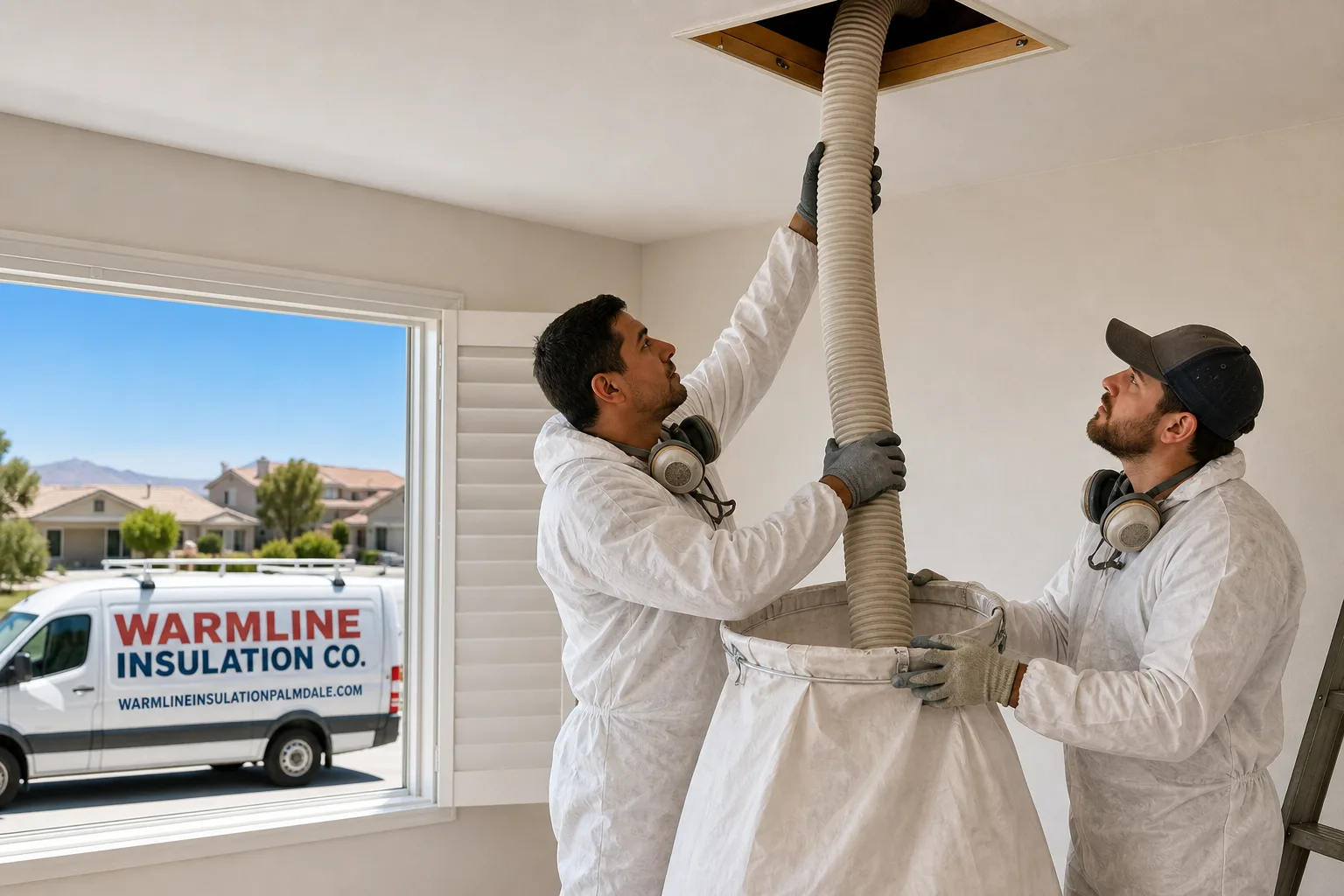
How Much Does Blown-In Insulation Cost in Palmdale?
Our Blown-In Insulation services in Palmdale, CA typically cost between $1,200 and $3,800 for a standard attic job, with most homeowners landing in the $1,600 to $2,600 range depending on attic size, current insulation levels, and whether air sealing is done at the same time. Cellulose and fiberglass blown-in both perform well in the Antelope Valley climate, but the right choice depends on your specific attic conditions. Most jobs are completed in a single visit.
Blown-In Insulation Cost Breakdown (2026)
Palmdale sits at roughly 2,700 feet in the Antelope Valley, which means your attic takes a beating from both directions – triple-digit summer heat radiating off the desert floor and cold winter nights that drop into the mid-20s. That thermal range makes proper insulation depth matter more here than in coastal markets where temperatures are mild year-round. Here’s what the numbers look like for jobs we quote regularly in Palmdale:
| Service / Scope | Typical Price Range (2026) |
|---|---|
| Small attic blown-in (up to 800 sq ft) | $1,200 – $1,700 |
| Mid-size attic blown-in (800 – 1,500 sq ft) | $1,600 – $2,400 |
| Large attic blown-in (1,500 – 2,500 sq ft) | $2,200 – $3,400 |
| Extra-large / custom attic (2,500+ sq ft) | $3,000 – $3,800+ |
| Attic air sealing (added to blown-in job) | $350 – $800 |
| Old insulation removal before blown-in | $600 – $1,400 |
| Blown-in for interior walls (per room) | $800 – $1,600 |
| Blown-in cellulose (material cost per bag) | $12 – $18 per bag |
| Blown-in fiberglass (material cost per bag) | $18 – $28 per bag |
These ranges reflect real Palmdale market pricing as of 2026, accounting for current material costs from brands like Owens Corning, GreenFiber, Johns Manville, and Knauf. Labor rates in the Antelope Valley have increased modestly over the past two years due to supply chain adjustments, but Palmdale remains more affordable than the LA Basin jobs we see closer to the 405.
One thing worth flagging: the target R-value for an attic in Palmdale under current California Title 24 and DOE recommendations is R-38 to R-60. If your existing insulation sits at R-11 or R-19 – which we often find in homes built before 1995 in neighborhoods like Quartz Hill or the older sections near Sierra Highway – you’re likely losing $30 to $80 per month in conditioned air you’ve already paid for. Topping up to R-49 or R-60 is usually the single highest-ROI home improvement available to a Palmdale homeowner.
If you’d like an exact number without the guesswork, call (661) 613-2043. A live person answers every call, and we’ll schedule a free estimate at a time that works for you.
What Affects Blown-In Insulation Pricing in Palmdale
No two attics are identical, and Palmdale homes in particular show a wide range of conditions depending on the decade they were built, the tract they’re part of, and how the previous owners maintained things. Here are the six factors that move the price up or down most reliably:
- Attic square footage and access difficulty. This is the single biggest driver. A 900-square-foot attic on a standard Palmdale ranch home takes far less material and labor than a 2,200-square-foot attic on a two-story home in a newer West Palmdale community. Low-pitch rooflines and limited access hatches also add time, which adds cost.
- Current insulation level. If your attic already has R-19 blown-in from the 1990s, topping up to R-49 costs less than starting from bare drywall. We see many older Palmdale homes – particularly those built in the 1970s and 1980s around areas like Anaverde and the older East Palmdale tracts – that still have the original 3-4 inches of matted fiberglass, which is a long way from code.
- Material choice: cellulose vs. fiberglass. GreenFiber cellulose is generally less expensive per bag and settles slightly over time (which we account for in our install depth). Owens Corning and Johns Manville fiberglass blown-in costs a bit more per bag but resists moisture better – a meaningful consideration for Palmdale homes near the edges of the valley where early morning condensation can be heavier than expected.
- Air sealing done at the same time. Palmdale’s desert climate means your attic sees extreme temperature swings – 105°F in July, 25°F on a January night. Without sealing the gaps around recessed lights, top plates, and HVAC penetrations, blown-in insulation alone does only part of the job. Adding air sealing to a blown-in project increases the total invoice by $350 to $800, but it also doubles the comfort and energy savings you’ll actually feel.
- Old insulation removal. If the existing insulation is damaged, rodent-contaminated, or contains vermiculite (which we sometimes encounter in pre-1980 Palmdale homes), it needs to come out before new material goes in. Removal adds $600 to $1,400 depending on depth and condition. We handle removal and fresh installation in the same visit whenever the attic allows it.
- HVAC duct condition and placement. Many Palmdale homes run ductwork through the attic. If ducts are poorly sealed or disconnected – which we find regularly in homes throughout the Rancho Vista and Desert Rose neighborhoods – that has to be addressed before we install insulation over the top of the problem. Duct sealing or repair is quoted separately and clearly before any work starts.
Palmdale-Specific Conditions That Change the Calculation
This section is worth reading if you live in Palmdale specifically, because the Antelope Valley has a few characteristics that make insulation decisions here different from what you’d read in a generic national cost guide.
Desert Heat Load
Palmdale regularly hits 105°F to 110°F from late June through September. Your attic air temperature during those months can hit 150°F or higher. At that temperature, an under-insulated ceiling isn’t just uncomfortable – your AC unit is fighting a losing battle. Blown-in insulation at R-49 to R-60 creates a genuine thermal break. Homeowners in communities like Crystalaire and the newer Landings at Anaverde tell us they see cooling bills drop by 20 to 35 percent after a proper blown-in job combined with radiant barrier installation, which is a combination we recommend for any Palmdale attic that faces south or west.
Cold Winters at Elevation
Palmdale averages 270 frost-free days per year, which sounds mild – but January lows regularly dip to 26°F to 30°F, and the high-desert wind chill can make an under-insulated home miserable. Blown-in insulation seals the attic floor from both sides of the thermal equation, which is why we see just as much demand for this service in November as in August.
Wildfire Smoke and Air Quality
Palmdale sits in a region with elevated wildfire risk, and air sealing your attic at the same time as your blown-in installation meaningfully reduces the amount of smoke infiltration during fire events. This is something most insulation contractors don’t mention, but it’s a real quality-of-life benefit we explain to every Palmdale homeowner we work with.
Title 24 and California Energy Code
California’s Title 24 energy code sets minimum insulation requirements for residential buildings. For Palmdale’s climate zone (Climate Zone 14), attic insulation is required to meet minimum standards during any permitted renovation or addition. If you’re planning to pull a permit for a room addition or HVAC replacement, your attic insulation may need to be brought up to current standards. We can walk you through what’s required so there are no surprises from the inspector.
How to Save on Blown-In Insulation in Palmdale
Blown-in insulation is one of the few home improvements where the savings start showing up on your next utility bill. Still, there are a few ways to keep the project cost down without cutting corners on material depth or quality.
Combine Services in One Visit
If you need air sealing AND blown-in insulation, scheduling them together costs significantly less than two separate trips. The same logic applies if you’re considering a radiant barrier – installing it before we blow in insulation means we’re not working around newly installed material. We complete most jobs in a single visit, and bundling services on that one visit is the most practical way to lower your per-service cost.
Use Available Utility Rebates
Southern California Gas (SoCalGas) and Southern California Edison (SCE) both offer rebates for insulation upgrades that meet efficiency thresholds. Rebate amounts change annually, but Palmdale homeowners have historically been able to recover $150 to $450 of their project cost through utility programs. Ask us about current rebate availability when you call – we’ve helped many Palmdale customers file for these without the paperwork runaround.
Schedule Off-Peak
Demand for insulation in Palmdale spikes in early summer (May through July) when homeowners feel their first big cooling bill. If your schedule allows, late winter or early spring – February through April – tends to mean quicker scheduling and occasionally better material availability. Winter is also a smart time to act because your heating bills are actively showing you the problem.
Take Advantage of Our Standing Discounts
- $50 Off Any Repair Over $250 – applies to blown-in jobs that include repair of existing insulation or damaged areas.
- $89 Seasonal Tune-Up – a great starting point if you want a professional assessment of your attic before committing to a full project.
- 5% Senior and Veteran Discount – permanent, no expiration date, applied to your total invoice. We serve a lot of veteran families in Palmdale and this discount never goes away.
To get an exact quote for your home’s specific attic size and conditions, call (661) 613-2043. We answer every call with a live person, not a voicemail, and we’ll get you a free estimate scheduled fast.
Start with a Home Energy Audit
If you’re not sure whether blown-in insulation is your highest-priority upgrade – or you want to know whether air sealing, radiant barrier, or crawl space work should come first – a home energy audit gives you a prioritized roadmap. We often find Palmdale homeowners who’ve been quoted a full attic project when half the heat loss was actually coming through an unsealed crawl space. Getting the diagnosis right before you spend money on materials is always the smarter path. Our home energy audit is the diagnostic starting point that makes every other service more targeted and more effective.
Blown-In vs. Batt Insulation: Which Makes More Sense for Palmdale Attics?
This question comes up on almost every estimate we run in Palmdale. The short answer is that blown-in wins in most existing homes, and here’s why:
Batt insulation – the pink fiberglass rolls most people picture – works well in new construction where you’re installing it between open studs or joists before drywall goes up. In an existing Palmdale attic, you’re dealing with irregular joist spacing, HVAC equipment, wiring runs, and corners that batts simply can’t fill without gaps. Those gaps are where your conditioned air escapes.
Blown-in cellulose or blown-in fiberglass fills every cavity, corners around obstructions, and achieves consistent depth across the entire attic floor. In a Palmdale attic with 150°F peak temperatures, consistency matters – a 10% coverage gap can account for 40% of your total heat gain. Blown-in is also faster to install in existing spaces, which keeps labor costs lower.
The one scenario where batts sometimes make sense is a new addition or an accessible, clean attic with standard joist spacing. We’ll tell you honestly which approach fits your situation when we do the walkthrough.
Blown-In Insulation for Walls in Palmdale
Attics get most of the attention, but wall insulation is a real issue in Palmdale’s older housing stock. Homes built before 1978 in neighborhoods like the older sections near 10th Street East or Avenue Q often have minimal or no wall insulation. The good news is that blown-in insulation can be added to existing walls without tearing off drywall – we drill small holes in an inconspicuous location (usually from the exterior, which we then patch and paint), inject the material, and patch clean.
Wall blown-in projects in Palmdale typically run $800 to $1,600 per room, depending on wall height and the number of penetrations needed. It’s a worthwhile investment in a west- or south-facing room that heats up in the afternoon regardless of how well your AC runs.
FAQs: Blown-In Insulation Cost in Palmdale
How much does blown-in insulation cost per square foot in Palmdale?
Blown-in insulation in Palmdale runs approximately $1.20 to $2.20 per square foot installed, depending on the target R-value, material type, and attic access conditions. A 1,500-square-foot attic brought up to R-49 typically falls in the $1,800 to $2,800 range all-in. For a precise number based on your specific home, call (661) 613-2043 – estimates are always free and there’s no obligation.
Is it cheaper to repair or replace old blown-in insulation?
Topping up existing blown-in insulation is almost always less expensive than full removal and replacement – typically 40 to 60 percent less – provided the existing material is dry, clean, and not contaminated by rodents or mold. If we find moisture damage, rodent feces, or heavily compacted material that’s fallen well below its rated R-value, removal is the right call and we’ll explain exactly why before any work begins. Full removal in Palmdale attics runs $600 to $1,400; a top-up on a clean existing base runs $600 to $1,200 for a typical mid-size attic. Call us and we’ll tell you honestly which route makes sense for your attic.
Can you install blown-in insulation the same day in Palmdale?
Yes, most blown-in insulation jobs in Palmdale are completed in a single visit, including attics up to 2,000 square feet. If we’re also doing air sealing or removing old insulation, we still typically finish the same day. The main exception is very large or complex attics where equipment access is significantly limited. We’ll give you a realistic time estimate when we schedule your free on-site walkthrough. Call (661) 613-2043 to get on the schedule.
What R-value do I need for my Palmdale attic in 2026?
The Department of Energy recommends R-38 to R-60 for attics in Palmdale’s climate zone (California Climate Zone 14). Most insulation professionals, including our team, aim for R-49 as the practical sweet spot – it satisfies Title 24 requirements and delivers measurable energy savings without the diminishing returns of going higher. We see most Palmdale homes built before 2000 sitting at R-11 to R-19, which means they’re leaving significant money on the table every month. If you’re curious where your attic stands, our free estimate includes a depth measurement and R-value assessment at no charge.
Does blown-in insulation qualify for any rebates or tax credits in Palmdale?
Yes. As of 2026, Palmdale homeowners can potentially access Southern California Edison and SoCalGas rebates for qualifying insulation upgrades, typically ranging from $150 to $450 depending on the scope and current program availability. Additionally, the federal Inflation Reduction Act’s Energy Efficient Home Improvement Credit (25C) provides a tax credit of up to 30% of insulation project costs, capped at $1,200 per year for qualifying homes and materials. Rebate programs change annually, so call (661) 613-2043 and ask us what’s currently active – we’ll help you identify every dollar you can recover.
How long does blown-in insulation last in a Palmdale attic?
Quality blown-in insulation from manufacturers like Owens Corning, GreenFiber, or Johns Manville has an effective lifespan of 20 to 40 years under normal conditions. The Antelope Valley’s heat extremes can cause fiberglass to lose some loft over time, which is why we install at depth values that account for expected settling. Cellulose, while excellent at air infiltration resistance, should be checked every 10 to 15 years in attics with any history of moisture. Both materials will outlast most other home improvements you’ll make, which is part of why the return on investment in Palmdale is so strong.
Why Palmdale Homeowners Choose Warmline Insulation Co.
Neil Ashford started Warmline Insulation Co. in 2011 with a straightforward premise: homeowners in the Antelope Valley deserve an insulation contractor who knows this specific climate, uses materials that actually perform here, and stands behind the work with something in writing. That’s where the 90-Day Done Right Promise comes from – if the work isn’t right, we make it right. Not a verbal commitment – a written one that competitors in the Palmdale market rarely match.
Neil’s team handles everything from attic air sealing and blown-in insulation to Blown-In Insulation in Palmdale projects across the full range of home sizes – from smaller single-story homes off Sierra Highway to larger two-story houses in newer West Palmdale developments. Every technician is background-checked and uniformed. Pricing is upfront before any work starts. And when you call (661) 613-2043, a live person picks up – no automated systems, no voicemail box.
Ten insulation and home-performance services under one contractor means you don’t need to manage multiple trades. Whether your home needs blown-in insulation, spray foam, crawl space encapsulation, a radiant barrier, or a full home energy audit to figure out where to start, it all happens through one point of contact. That’s a meaningful difference when you’re trying to get a job done correctly and move on with your life.
We’ve been serving Palmdale and the surrounding Antelope Valley since 2011. Over those fifteen years, we’ve insulated homes in nearly every neighborhood in the city – from Rancho Vista to Anaverde, from the older East Palmdale tracts to the newer communities near Avenue S. We know what the inspectors look for, what the utility rebate programs require, and where the common problems hide in this market’s housing stock. That local knowledge is part of what you get when you call us.
If you’re a senior or veteran homeowner, ask about our permanent 5% Senior and Veteran discount – it applies to every project, every time, with no expiration.
Key Takeaways: Blown-In Insulation Costs in Palmdale (2026)
- Most Palmdale attic blown-in jobs cost between $1,600 and $2,600, with the range spanning $1,200 to $3,800+ depending on size and scope.
- The target R-value for Palmdale attics is R-38 to R-60; most pre-2000 homes fall well short of that.
- Adding air sealing to a blown-in project costs $350 to $800 more but delivers a proportionally larger improvement in both comfort and utility bills.
- Blown-in insulation qualifies for utility rebates from SCE and SoCalGas, plus the federal 25C tax credit (up to 30%, capped at $1,200/year).
- Palmdale’s desert heat extremes, cold winters, and wildfire smoke conditions make proper attic insulation and air sealing more important here than in most California markets.
- Warmline Insulation Co. backs all work with a written 90-Day Done Right Promise and has served Palmdale since 2011.
- Free estimates, upfront pricing, and most jobs completed in a single visit. Call (661) 613-2043 – a live person answers every call.
Ready to Find Out Exactly What Your Palmdale Home Needs?
The fastest way to get a real number is a free on-site estimate. We’ll measure your attic, check your current insulation depth, identify any air sealing or moisture issues, and give you upfront pricing before any work is discussed. No pressure, no vague ranges – just a clear picture of what your home needs and what it’ll cost.
Call (661) 613-2043 today. A live person will pick up, get your information, and put you on the schedule. For Palmdale homeowners who want to start with a broader look at what we do, visit our home page to see the full range of insulation and home-performance services we offer.
Blown-in insulation is one of the highest-ROI improvements a Palmdale homeowner can make. At R-49 or better, most of our customers feel the difference the first night after the job is done – and see it on their utility bill the following month.
Written by Neil Ashford, Owner at Warmline Insulation Co., serving Palmdale, CA since 2011.
Pricing reflects the Palmdale market as of 2026. Warmline Insulation Co. offers free estimates – call (661) 613-2043.
What Our Customers Say
"They did the energy audit first - blower door and thermal camera - and showed me exactly where the house was leaking before selling me anything. The fix ended up being air sealing plus a modest attic top-up, not the full replacement another company pushed."
- Grace Nakamura"Upstairs was ten degrees hotter than downstairs every summer. They pulled the attic to bare joists, air-sealed every can light and top plate first, then blew it to R-49. First August in this house where the bedrooms and the living room read the same on the thermostat."
- Marcus Hale"Crawl space smelled musty and the floors were cold. Full encapsulation with the thick liner taped at every seam, and a dehumidifier sized for the space. The hygrometer they left reads 48 percent now instead of the 70s."
- Elena Vasquez