
How Much Does Insulation Removal & Replacement Cost in Palmdale?
Insulation removal and replacement in Palmdale, CA typically runs between $1,200 and $4,800 for a standard single-story home, with most homeowners landing around $2,400 when you factor in attic cleanup, disposal, and fresh blown-in or batt installation. Palmdale’s extreme temperature swings – triple-digit summers and below-freezing nights in January – mean undersized or damaged insulation costs you money every single month, so the math on replacement usually works in your favor faster than most homeowners expect.
If you want a number specific to your home, our Insulation Removal & Replacement in Palmdale service page walks through what’s included in a typical job, and you can call (661) 613-2043 – a live person answers, 24/7 – to get a free, no-pressure estimate.
Insulation Removal & Replacement Cost Breakdown (2026)
Insulation removal and replacement in Palmdale typically costs between $1,200 and $4,800 for a standard home, depending on square footage, insulation type, and the condition of what’s already up there. The table below reflects real pricing in the Antelope Valley market as of 2026 – not national averages padded with contingency.
| Service Component | Typical Palmdale Cost Range | Notes |
|---|---|---|
| Blown-in insulation removal (attic) | $400 – $900 | Based on 1,000-2,000 sq ft attic; includes vacuum extraction and bagging |
| Batt insulation removal (attic or walls) | $300 – $700 | Fiberglass or mineral wool batts; labor-intensive if rodent-soiled |
| Disposal and haul-away | $150 – $400 | Higher end applies to pest-contaminated or asbestos-era material requiring special handling |
| Attic sanitizing and deodorizing | $200 – $500 | Recommended after rodent activity – common in Palmdale’s desert-edge neighborhoods |
| Air sealing before reinstallation | $250 – $600 | Sealing bypasses around recessed lights, top plates, and penetrations; significantly improves ROI |
| Blown-in fiberglass or cellulose replacement (attic) | $600 – $1,800 | Owens Corning or GreenFiber material to R-38 or R-49; range reflects attic size |
| Fiberglass batt replacement (walls or crawl space) | $500 – $1,400 | Knauf or CertainTeed batts; labor higher if access requires drywall work |
| Spray foam reinstallation (rim joists, problem areas) | $350 – $900 | Icynene or Demilec two-component foam; typically spot-applied, not whole-attic |
| Radiant barrier addition at reinstallation | $400 – $800 | Popular add-on for Palmdale homes; cuts radiant heat gain by 25-35% in summer |
| Full attic removal + replacement (complete job) | $1,200 – $4,800 | Most common scope; includes removal, disposal, air sealing, and reinstallation |
What Moves the Price Up or Down
The single biggest variable is square footage. A 900 sq ft attic in a smaller ranch home in the West Palmdale area costs meaningfully less to clear and refill than a 2,400 sq ft attic in a two-story home near Rancho Vista Boulevard. But square footage isn’t the whole story.
Contamination adds cost. Palmdale sits at the edge of the Mojave Desert, and the desert brings rodents – roof rats, mice, and occasionally squirrels find their way into attics in areas like Oak Tree Village and the neighborhoods off 40th Street East. When insulation has been used as nesting material, it has to be treated as a biohazard, bagged separately, and the attic surfaces sanitized before new insulation goes in. That process adds $200 to $500 to the total, but skipping it means the odor and bacteria stay behind forever.
Attic access matters more than most people realize. A wide pull-down stair makes vacuum extraction straightforward. A 16-inch hatch above a closet shelf adds labor time. Homes in older Palmdale neighborhoods built in the 1970s and early 1980s sometimes have both tight access and fragile drywall ceilings, which slows the job.
The type of replacement insulation changes the number too. Blown-in cellulose from GreenFiber hits R-38 at a lower material cost than premium open-cell spray foam, but spray foam seals air gaps simultaneously – which is why we often recommend it for rim joists and difficult corners even when blown-in handles the main field. Rockwool mineral wool batts are another option we use when fire resistance is a priority, and they cost slightly more than fiberglass but outperform it in Palmdale’s temperature extremes.
What Affects Insulation Removal & Replacement Pricing in Palmdale
- Attic or crawl space square footage: Labor and material costs scale directly with area. A 1,200 sq ft attic is roughly the Palmdale median for single-story homes built in the 1990s. Every additional 500 square feet adds approximately $300 to $600 to the total depending on what’s going back in.
- Condition of existing insulation: Dry, intact blown-in that’s simply aged past its useful R-value is the cheapest scenario to clear. Wet, rodent-damaged, or mold-affected insulation requires protective equipment, special disposal bags, and sanitizing treatment – easily adding $300 to $700 to the base removal cost.
- Palmdale’s climate demands a higher R-value target: Title 24, California’s energy code, requires attic insulation in Climate Zone 14 (which covers most of Palmdale) to reach at least R-38. Many contractors aiming for minimum code stop there. We typically recommend R-49 for homes in the Antelope Valley because the temperature delta between your attic and your living space can exceed 60 degrees on a July afternoon – minimum code does the minimum job.
- Presence of hazardous materials: Homes built before 1980 in older Palmdale communities occasionally have vermiculite or older blown-in material that requires asbestos testing before any removal begins. If testing confirms asbestos-containing material, licensed abatement is required and costs more – typically $1,500 to $3,500 for attic-scale removal – but it’s non-negotiable for safety and legal compliance.
- Air sealing scope: Adding thorough air sealing before the new insulation goes in raises upfront cost by $250 to $600 but typically cuts heating and cooling bills by 15 to 25 percent. In a Palmdale home running the AC for six or seven months a year, that payback is usually under three years.
- Access difficulty and job complexity: Two-story homes, homes with knee-wall attics, and properties with minimal attic clearance take longer to work in. Neighborhoods like Rancho Palmdale and the hillside streets north of Avenue P often have non-standard attic configurations that add an hour or two of labor compared to a flat-ceiling ranch home.
Signs You Actually Need Removal – Not Just a Top-Off
Not every situation calls for full removal. Sometimes a top-off is the right call. But in Palmdale, we see four scenarios that almost always require pulling the old material out first before anything new goes in.
The first is pest activity. When rodents nest in attic insulation, their urine soaks into the material and breaks down its fiber structure. The insulation loses R-value and becomes a health hazard. Adding new insulation on top does nothing except give the contamination a new layer to hide under. In Quartz Hill and Littlerock-adjacent neighborhoods where the desert scrub comes right up to the property line, we see this regularly – usually caught during our initial inspection before we quote anything.
The second is moisture damage. Palmdale averages fewer than 8 inches of rain per year, but when roofs leak or HVAC condensate lines fail, attic moisture soaks fiberglass batts completely. Wet insulation has effectively zero R-value and promotes mold. Once the moisture source is repaired, the insulation has to come out.
The third is age-related settling. Blown-in fiberglass installed before 2000 often settled 30 to 50 percent from its original depth. If your attic currently measures 4 inches of settled blown-in, adding more on top is structurally fine but leaves you with an uneven R-value that can’t be reliably calculated. Starting fresh gives you a known baseline.
The fourth is pre-renovation work. If you’re adding recessed lights, running new HVAC ducts, or adding a whole-house fan, the existing insulation needs to be cleared anyway. We coordinate with other trades regularly in Palmdale homes and can sequence the job so nothing gets buried under new material before the rough work is signed off.
The Replacement Process: What Actually Happens
A lot of homeowners aren’t sure what our Insulation Removal & Replacement services actually look like from their side. Here’s the honest version.
We start with an attic inspection – not a sales pitch, an actual look at what’s up there. Neil Ashford and the Warmline team use this inspection to document existing R-value depth, check for moisture or pest evidence, note air sealing deficiencies, and photograph conditions so you can see exactly what we’re seeing. This is also where we flag anything that needs to go to a specialist first, like active rodent infestations or suspected asbestos material that should be tested before anyone starts moving it around.
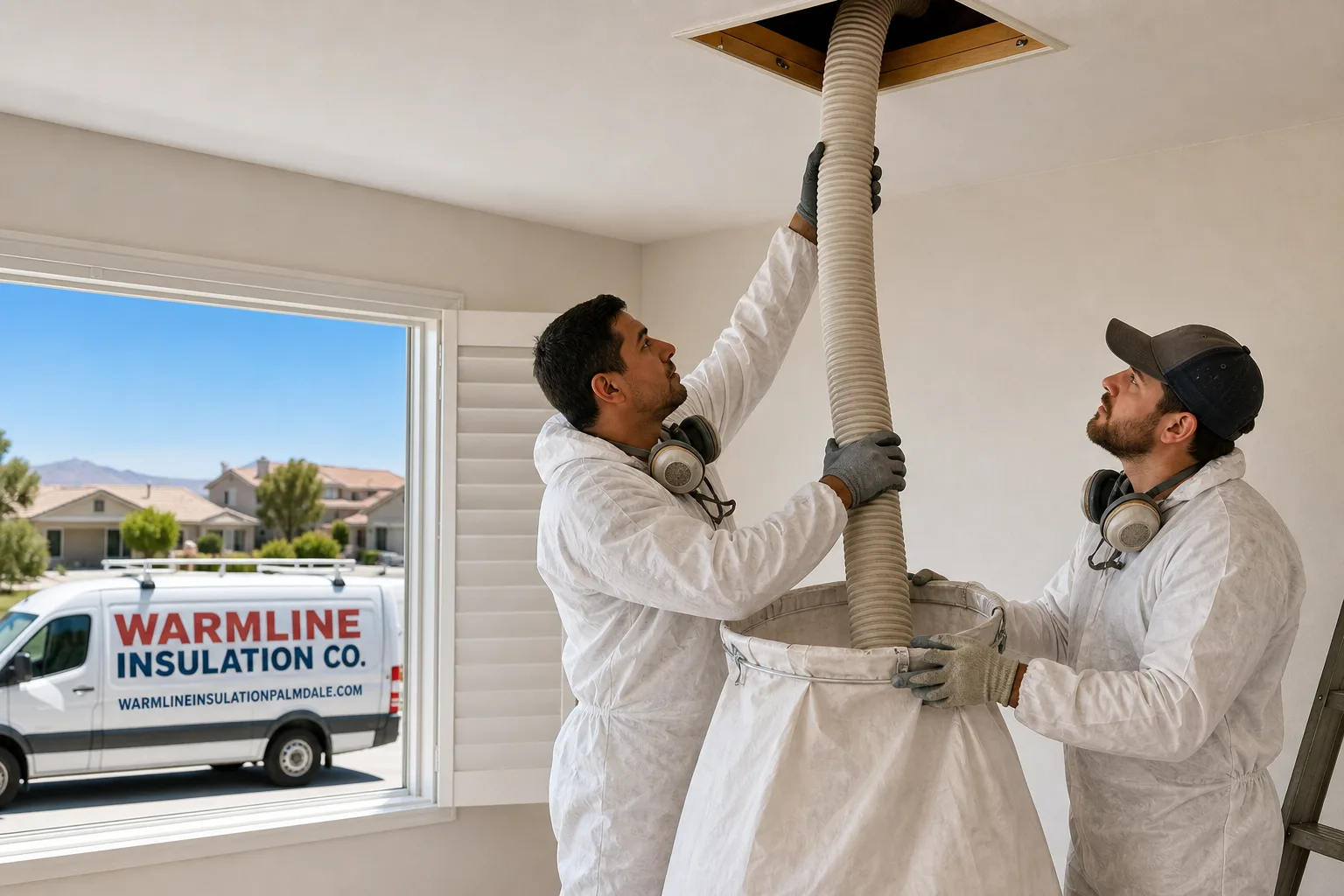
Removal uses commercial-grade vacuum extraction equipment. The hose runs from an industrial vacuum truck through the attic access point, and the old material gets pulled out, bagged in sealed poly bags, and hauled off the same day. A typical 1,500 sq ft attic takes two to four hours to clear.
After the attic floor is clear, any necessary sanitizing happens before the air sealing work. We use spray foam – Icynene or Demilec depending on the application – to seal top plates, penetrations, recessed light cans, and any gaps larger than a quarter inch. This step is invisible once the new insulation goes in, but it’s where a significant portion of the energy savings comes from. An attic with great insulation and no air sealing is still a leaky attic.
New insulation goes in last. For most Palmdale attics we’re installing blown-in fiberglass or cellulose – Owens Corning or GreenFiber – to R-38 minimum, more often R-49 given local conditions. Depth markers get installed so you and any future inspector can verify coverage without guessing. We clean up, take final photos, and the written record goes to you at job close.
Most jobs are completed in a single visit. For larger homes or those requiring sanitizing plus air sealing plus reinstallation, a two-day schedule is sometimes more practical – but we’ll tell you that up front when we quote the job, not after we’ve started.
How to Save on Insulation Removal & Replacement
There are a few practical ways to reduce the total cost without cutting corners on the work itself.
Bundle air sealing with the removal job. Air sealing done as a standalone service after new insulation is installed requires moving or temporarily pulling back material to reach the bypasses. Done at the same time as removal – when the attic floor is completely clear – it takes a fraction of the labor time and costs considerably less. We always recommend sequencing the two together.
Get a home energy audit first. A home energy audit before any insulation work helps you spend money where it produces the biggest return. In some Palmdale homes, the attic is in reasonable shape but the crawl space vapor barrier is the real problem. In others, wall insulation is missing on the north side of the house. An audit tells you which fix pays back fastest – and it prevents paying for a full attic removal when a partial job would have done the work.
Use our standing discounts. Veterans and seniors receive a permanent 5% discount on all services. Any repair over $250 qualifies for $50 off. These offers stack when applicable, and we apply them automatically – you don’t need a code or a coupon.
Ask about utility rebates. Southern California Gas and Southern California Edison both run rebate programs tied to insulation upgrades that meet specific R-value thresholds. Program availability and amounts change year to year, but we stay current on what’s active for Palmdale-area customers and can point you toward what’s worth applying for at the time of your job.
Don’t wait on known damage. Pest-contaminated or moisture-damaged insulation that sits for another 12 months doesn’t stay the same – it gets worse, and the remediation cost grows. More importantly, every month that damaged insulation stays in place, your HVAC system is working harder than it should be in Palmdale’s heat. The longer you wait, the more you’ve paid in utility bills on top of the eventual repair cost.
Call (661) 613-2043 to schedule a free estimate. You’ll speak to a live person – not voicemail – and we can usually get eyes on your attic within a day or two.
FAQs – Insulation Removal & Replacement Cost in Palmdale
How much does insulation removal cost in Palmdale, CA?
Insulation removal in Palmdale typically costs $300 to $900 for an attic, depending on size, insulation type, and whether pest or moisture contamination requires additional handling. A 1,200 sq ft attic with standard blown-in and clean conditions runs around $450 to $600 for removal and disposal. Contaminated material – rodent activity, moisture damage, or suspected hazardous content – adds $200 to $700 on top of that base. Call (661) 613-2043 for a free estimate specific to your home – our quotes don’t change between the phone and the job site.
Is it cheaper to remove old insulation or just add more on top?
Adding blown-in insulation on top of existing material costs $600 to $1,200 less than a full removal-and-replacement job – when it’s the right call. It’s genuinely the right approach when existing insulation is dry, pest-free, and at least partially intact. But if the material is contaminated, soaked, or has settled below a functional R-value, topping it off doesn’t solve the problem – it buries it. We’ll tell you honestly during the inspection which scenario you’re in, and we won’t push removal if a top-off is actually the better answer.
How much does blown-in insulation replacement cost per square foot in Palmdale?
Blown-in insulation replacement in Palmdale runs approximately $0.80 to $1.80 per square foot for material and installation, depending on target R-value and product selected. Reaching R-38 with GreenFiber cellulose sits at the lower end of that range; stepping up to R-49 with Owens Corning blown-in fiberglass lands at the higher end. Those figures don’t include removal of existing material, which is priced separately. For a 1,500 sq ft attic at R-49, expect $1,200 to $2,700 for the replacement portion of the job alone.
Do I need a permit for insulation replacement in Palmdale?
For most like-for-like insulation replacements in Palmdale, no building permit is required. Los Angeles County building code (which governs unincorporated Palmdale-adjacent areas) and the City of Palmdale both generally classify standard attic insulation replacement as a maintenance activity rather than new construction. However, if the project involves changing the insulation type, adding spray foam to areas not previously insulated, or if it’s part of a larger renovation with a permit already pulled, a separate insulation permit may apply. We handle permit questions as part of the scoping conversation – if a permit is needed, we’ll tell you before the job starts.
How long does insulation removal and replacement take in Palmdale?
Most standard Palmdale attic jobs – removal, air sealing, and reinstallation – are completed in one day, typically six to nine hours for a 1,200 to 1,800 sq ft attic. Larger homes, attics with heavy contamination requiring thorough sanitizing, or projects that include crawl space work alongside the attic may run into a second day. We schedule honestly – if your job needs two visits, we say so in the estimate, not after we’ve started. Either way, the home is fully functional the same day we finish.
Can you add a radiant barrier when replacing insulation?
Yes, and in Palmdale we recommend it for most attic replacement projects. A radiant barrier reduces attic heat gain by 25 to 35 percent in summer, which directly lowers the load on your air conditioner during the months when Palmdale temperatures regularly exceed 100 degrees. Installation adds $400 to $800 to the job when done at the same time as replacement – significantly less than having it installed as a standalone project later. It’s one of the better return-on-investment add-ons for homes in the Antelope Valley specifically.
Why Palmdale Homeowners Choose Warmline Insulation Co.
Neil Ashford founded Warmline Insulation Co. in 2011 with a straightforward idea: homeowners in the Antelope Valley deserve an insulation contractor who treats the work as a building-science problem, not a commodity job. Fifteen years later, that’s still how every estimate and every installation gets approached.
Every technician we send to your home is background-checked and uniformed. Pricing is upfront before any work starts – no estimate-to-invoice surprises. If something isn’t right after the job closes, our 90-Day Done Right Promise covers it in writing, which is a commitment most competitors won’t put on paper. And when you call (661) 613-2043, a live person picks up – every time, any hour.
We work with materials from Owens Corning, Rockwool, CertainTeed, Icynene, Demilec, Johns Manville, Knauf, and GreenFiber because those are the products that perform in Palmdale’s climate and hold up over time. We don’t substitute materials after a quote is approved, and we don’t cut depth on blown-in jobs to save time.
For homeowners in Palmdale’s west side neighborhoods, in communities like Quartz Hill, or in the newer developments near Avenue S and 60th Street West, the combination of desert heat, cold winters, and aging housing stock makes insulation one of the highest-return home improvements available. We’ve been making that case – and backing it with real results – since 2011.
Call (661) 613-2043 for a free estimate. No voicemail, no runaround – just a straight answer from someone who knows Palmdale insulation work.
Pricing reflects the Palmdale market as of 2026. Warmline Insulation Co. offers free estimates – call (661) 613-2043.
Written by Neil Ashford, Owner at Warmline Insulation Co., serving Palmdale since 2011.
What Our Customers Say
"They did the energy audit first - blower door and thermal camera - and showed me exactly where the house was leaking before selling me anything. The fix ended up being air sealing plus a modest attic top-up, not the full replacement another company pushed."
- Grace Nakamura"Upstairs was ten degrees hotter than downstairs every summer. They pulled the attic to bare joists, air-sealed every can light and top plate first, then blew it to R-49. First August in this house where the bedrooms and the living room read the same on the thermostat."
- Marcus Hale"Crawl space smelled musty and the floors were cold. Full encapsulation with the thick liner taped at every seam, and a dehumidifier sized for the space. The hygrometer they left reads 48 percent now instead of the 70s."
- Elena Vasquez