
How Much Does Spray Foam Insulation Cost in Palmdale?
Our Spray Foam Insulation services in Palmdale, CA typically cost between $1,800 and $6,500 for a whole-home project, or roughly $1.00 to $3.50 per board foot depending on the foam type, application area, and your home’s current condition. Open-cell foam runs cheaper, closed-cell costs more but performs better in Palmdale’s climate swings, and most jobs are completed in a single visit. If you want a number specific to your home, call (661) 613-2043) – a live person answers every time, and estimates are free.
Spray Foam Insulation Cost Breakdown (2026)
Palmdale’s housing stock skews toward 1970s-era ranch homes, newer tract construction from the early 2000s, and a growing number of custom builds up toward the Antelope Valley foothills. Each generation of home has different insulation demands, which is why spray foam pricing isn’t one-size-fits-all here. Below are the real ranges we see in this market, not national averages pulled from somewhere else.
| Application Area | Foam Type | Typical Price Range (Palmdale, 2026) |
|---|---|---|
| Attic (1,200-1,500 sq ft home) | Open-cell | $1,800 - $3,200 |
| Attic (1,200-1,500 sq ft home) | Closed-cell | $2,800 - $4,800 |
| Crawl space or floor joists | Closed-cell (2-inch lift) | $1,200 - $2,600 |
| Rim joists and band joists | Closed-cell | $400 - $900 |
| Garage ceiling / bonus room | Open-cell or closed-cell | $800 - $2,000 |
| New construction walls (per 1,000 sq ft of wall) | Open-cell | $900 - $1,800 |
| New construction walls (per 1,000 sq ft of wall) | Closed-cell | $1,600 - $3,200 |
| Full home air sealing + spray foam combo | Mixed (open + closed-cell) | $3,500 - $6,500 |
A few things drive those numbers. First, foam type: closed-cell foam from brands like Icynene or Demilec has a higher material cost because it delivers a higher R-value per inch (around R-6 to R-7 per inch vs. R-3.5 to R-4 for open-cell) and acts as a vapor barrier. In Palmdale’s desert climate, where you can see 110-degree summer days in Quartz Hill and 28-degree winter nights up near Pearblossom Highway, that density matters for both cooling season and heating season. Second, job size: foam is mixed on-site with specialized equipment, so the setup cost is spread across more square footage on bigger jobs, which brings the per-board-foot price down. Third, existing insulation condition: older homes with degraded batt insulation or blown-in that has settled need removal before foam can be applied, and that adds labor. We include removal in our scoped quotes so there are no line-item surprises on install day.
If your home is one of the many 1980s or 1990s builds in neighborhoods like Rancho Vista or Sun Village, it’s quite common to find R-11 or R-13 batts in the walls – well below what California Energy Code now recommends for Climate Zone 14, which covers most of Palmdale. Bringing those homes up to current performance with spray foam typically lands in the $2,500 to $4,500 range for attic and rim joist work combined.
What Affects Spray Foam Insulation Pricing in Palmdale
- Foam type: open-cell vs. closed-cell. Open-cell foam is lighter and less expensive, good for interior walls and attic rafters where vapor control is less critical. Closed-cell is denser, more expensive, and the right choice for exterior walls, crawl spaces, and anywhere you need a vapor barrier. In Palmdale’s desert heat, most attic applications benefit from closed-cell’s superior thermal resistance.
- Total square footage and thickness required. California’s Title 24 energy code for Climate Zone 14 sets minimum R-values that directly dictate how thick the foam lift needs to be. A 2-inch closed-cell application gives you roughly R-13; hitting R-21 for a vaulted ceiling means a 3-inch lift. More thickness equals more material, and material is the primary cost driver in spray foam.
- Accessibility and attic or crawl space conditions. Palmdale homes with tight attic knee walls, low-pitch rooflines, or crawl spaces with standing moisture from winter rains take more labor time and sometimes require pre-treatment before foam can be applied. We see this regularly in older homes on the west side of Palmdale near the areas off Sierra Highway – the attics are cramped, and labor time reflects that.
- Existing insulation removal. If there’s old blown-in fiberglass or deteriorated batt insulation that needs to come out before foam goes in, removal adds $500 to $1,500 depending on the volume and condition. Damaged or pest-compromised insulation should always be removed – applying foam over rodent-contaminated material is a health and performance problem, not a shortcut.
- Desert heat and seasonal scheduling. Spray foam is temperature-sensitive during application. The ideal substrate temperature is between 60 and 90 degrees Fahrenheit. During Palmdale’s summer months, when attic temperatures can hit 140 degrees by mid-afternoon, crews typically schedule foam work in the early morning. Jobs requiring afternoon starts in summer may carry a small scheduling premium or require more product conditioning on site.
- Air sealing scope. Spray foam seals as it insulates, but truly high-performance results come from a dedicated attic air sealing pass before the main foam application. Adding comprehensive air sealing to a spray foam project adds $300 to $800 to the job but often delivers a bigger energy-bill reduction than the foam alone. We run a free home energy audit for customers who want to understand exactly where their conditioned air is escaping before we start.
Open-Cell vs. Closed-Cell Foam: Which One Does Palmdale’s Climate Demand?
This question comes up on nearly every estimate we run in Palmdale, so it deserves a direct answer rather than a hedged “it depends.”
Open-cell foam works well for interior applications: interior partition walls, between floors in two-story homes, and attic rooflines where a vapor-permeable material is acceptable or desirable. It’s softer, expands aggressively to fill cavities, and costs less per board foot. Brands like Icynene and Johns Manville both make reliable open-cell products we use regularly.
Closed-cell foam is what most Palmdale homeowners need for their primary thermal envelope work. Here’s why: the Antelope Valley sits at roughly 2,700 feet elevation, and the temperature swings are real. Summers regularly push over 100 degrees on the valley floor, but winters drop hard, especially in December and January when overnight lows in the low 30s aren’t unusual. Closed-cell foam’s higher R-value per inch means you achieve your target performance in less depth, which matters in tight wall cavities. It also functions as a Class II vapor retarder, which is useful in Palmdale’s occasionally wet winters when the Antelope Valley gets those brief but heavy storm systems off the Pacific.
For most attic and crawl space projects in Palmdale, we spec closed-cell foam from Demilec or Icynene. For whole-home new construction or large-scale retrofits, a hybrid approach – closed-cell on the exterior-facing surfaces and open-cell deeper in the cavity – can hit your performance targets at a lower total cost. We’ll tell you exactly which combination makes sense for your home, not for our margin.
Spray Foam vs. Other Insulation Types: A Cost Comparison for Palmdale Homeowners
Spray foam is not always the lowest-cost option upfront, and we think it’s important to say that plainly. Here’s how it compares to the other options we install for Palmdale homeowners:
- Blown-in fiberglass or cellulose: $0.40 to $0.90 per square foot for attic applications. Much lower upfront cost, good R-value, but zero air sealing benefit. If your home leaks air – and most Palmdale homes built before 2005 do – blown-in alone won’t stop it.
- Batt insulation (Owens Corning or CertainTeed): $0.50 to $1.20 per square foot installed. Works for new construction walls when installed correctly and with proper vapor control. Gaps and compression kill performance, which is why batt-only installs often underperform their rated R-value.
- Spray foam (open-cell): $1.00 to $1.75 per board foot. Mid-range cost, excellent air sealing, good R-value, appropriate for interior applications.
- Spray foam (closed-cell): $1.80 to $3.50 per board foot. Highest upfront cost, highest R-value per inch, vapor control, structural rigidity benefit in walls. Longest service life of any insulation type we install.
- Radiant barrier: $0.25 to $0.65 per square foot. Palmdale’s extreme solar gain makes radiant barriers a strong complement to foam in attics – they address a different heat transfer mechanism (radiation vs. conduction) and the two work well together.
The reason homeowners in places like Anaverde Hills or the newer developments near 47th Street East choose spray foam over blown-in isn’t the R-value on paper – it’s that foam seals and insulates in one application, and that air sealing typically cuts 20 to 40 percent off heating and cooling load. Over a 10-year ownership period, the math usually favors foam when you’re starting from a leaky attic.
If you want to see how the insulation types compare for your specific home, our Spray Foam Insulation in Palmdale service page covers the full process, and a free home energy audit – one of the ten services we offer under one roof – will give you real blower-door numbers before you commit to anything.
How to Save on Spray Foam Insulation in Palmdale
Spray foam has a real upfront cost. Here are practical ways to reduce what you spend, or make sure you’re spending it in the right places.
1. Get the audit before the quote.
A home energy audit with a blower door test tells you precisely where conditioned air is escaping. In Palmdale, the most common culprits are attic bypasses at recessed lights, gaps at the top plates of interior walls, and unsealed penetrations around plumbing in homes built in the 1990s. If you spray foam the wrong areas, you’ve spent money without fixing the problem. The audit costs a fraction of a foam job and eliminates guesswork.
2. Prioritize the attic first.
In Palmdale’s climate, the attic is almost always the highest-return investment. Heat gain through an under-insulated attic in July is the single biggest driver of high SoCalGas and LADWP bills for homeowners here. Starting with the attic rather than trying to do the whole home at once lets you see real energy bill changes and then decide whether to phase in wall or crawl space work.
3. Combine air sealing with your foam project.
Adding dedicated air sealing to a foam job costs less when it’s done in the same visit than as a standalone return trip. The setup – drop cloths, equipment, crew time – is already on site. Ask for it to be scoped together and you’ll typically save $150 to $300 compared to scheduling it separately.
4. Ask about the Senior and Veteran discount.
We offer a permanent 5% discount for seniors and veterans. On a $4,000 foam project, that’s $200 back in your pocket. Mention it when you call – it applies to the whole job, not just materials.
5. Use the $50 off any repair over $250 offer.
If your project includes any repair work – existing damaged insulation removal, air sealing repairs, or related attic work – ask about our $50 off any repair over $250 offer. It stacks on top of the Senior and Veteran discount.
6. Check for utility rebates.
Southern California Gas Company and LADWP both run rebate programs for insulation upgrades that meet certain efficiency thresholds. The programs change annually and have income-based tiers, so we recommend checking current availability when you call for your estimate. We’re familiar with the paperwork and can tell you whether your planned project is likely to qualify.
7. Call (661) 613-2043 for a free estimate – not a ballpark.
Generic online calculators will give you a national average that may not reflect what’s actually involved in your specific home. Our estimates are free, upfront, and based on what we see in your attic and crawl space – not a formula. A live person will pick up when you call, and we can usually schedule an estimate within a day or two for Palmdale homeowners.
FAQs – Spray Foam Insulation Cost in Palmdale
How much does spray foam insulation cost per square foot in Palmdale?
Spray foam in Palmdale costs roughly $1.00 to $1.75 per board foot for open-cell and $1.80 to $3.50 per board foot for closed-cell, with most residential attic projects landing between $1,800 and $4,800 total depending on the size and foam type. Board foot pricing means one square foot of area at one inch of thickness – so a 1,500 square foot attic sprayed at 3 inches of closed-cell is 4,500 board feet of foam. Call (661) 613-2043 for a free estimate specific to your home’s square footage and current condition.
Is spray foam insulation worth the cost in Palmdale’s climate?
For most Palmdale homeowners, yes – particularly for attic applications. Palmdale sits in California Climate Zone 14, where summer cooling loads are extreme and winter nights get genuinely cold. Spray foam’s combination of high R-value and air sealing typically reduces HVAC runtime by 20 to 40 percent compared to older fiberglass batt systems. On a home spending $250/month in summer on electricity, that’s $50 to $100 per month recovered. Over five to seven years, the foam usually pays for itself in energy savings, and it doesn’t settle, sag, or degrade the way blown-in or batt insulation can over time in Palmdale’s heat cycles.
Can spray foam be installed in an existing Palmdale home, or is it only for new construction?
Spray foam works in existing homes, and the majority of the projects we complete in Palmdale are retrofits, not new builds. The most common retrofit applications are attic roofline and floor applications, rim joists, and crawl space floors and walls. For enclosed wall cavities in an existing home, injection foam is typically a better fit than spray foam since it doesn’t require opening the walls. We’ll tell you which approach makes sense for your specific situation – no upselling to a more expensive option if it’s not warranted.
How long does spray foam insulation installation take in Palmdale?
Most spray foam jobs in Palmdale are completed in a single day, and many finish in four to six hours for a standard attic application on a 1,400 to 1,800 square foot home. Larger projects combining attic, crawl space, and wall work may run into a second day. The foam itself reaches a tack-free state within minutes and is fully cured within 24 hours. We schedule most Palmdale jobs within a week of the estimate, and the home is livable the same day the foam is applied.
Does spray foam insulation require any permits in Palmdale?
In most cases, spray foam insulation applied in existing homes in Palmdale does not require a building permit, particularly for attic and crawl space work. However, new construction projects and any work that materially changes the thermal envelope in a permitted project will need to comply with California Title 24 documentation and may require inspection. We’re familiar with City of Palmdale and Los Angeles County permit requirements and will let you know at the estimate stage whether your project triggers a permit. We handle the paperwork when it’s needed – that’s part of what “one contractor for the full job” actually means.
What’s the difference between spray foam and blown-in insulation for an attic in Palmdale?
Blown-in insulation – typically fiberglass or cellulose – adds R-value but does nothing to stop air infiltration. Spray foam adds R-value and seals the attic air boundary at the same time. In Palmdale homes, where attic bypasses around recessed lights, wire penetrations, and top plates are common, blown-in alone often leaves a significant portion of the heat gain problem unsolved. The tradeoff is cost: blown-in runs $0.40 to $0.90 per square foot vs. $1.00 to $3.50 per board foot for foam. For older Palmdale homes with lots of air leakage, foam typically delivers better real-world results; for newer construction that’s already reasonably tight, blown-in or a foam-plus-blown-in hybrid can be a cost-effective choice. Our energy audit will tell you which makes more sense for your home before you spend a dollar on materials.
What the Installation Process Looks Like at Your Palmdale Home
A lot of homeowners have never had spray foam installed before and aren’t sure what to expect on the day of the job. Here’s a plain-language walkthrough of how a typical attic foam project runs at a Palmdale home.
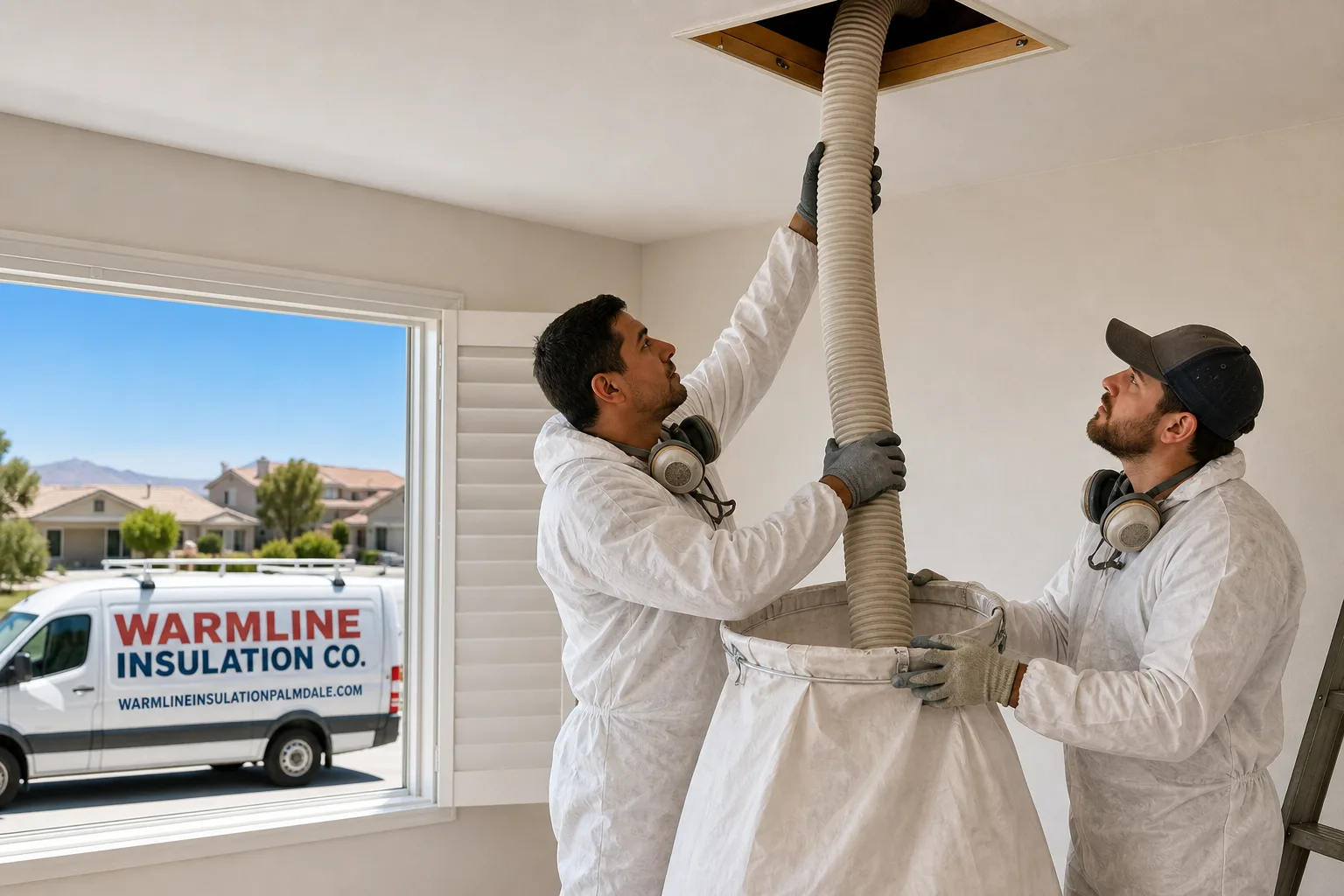
We arrive in the morning – usually before 9 a.m. during summer months to beat the attic heat – in a marked company vehicle, uniformed, and ready to go. The crew does a walkthrough with you first to confirm scope, point out anything that changed since the estimate, and cover any questions you have. The attic is prepped: existing insulation is removed if that’s in scope, any damaged or pest-compromised material is bagged and taken out, and the surfaces are inspected. We do a pass for attic air sealing – caulking and foam-blocking the major bypasses at top plates, plumbing penetrations, and recessed light housings – before the spray foam application begins.
The spray foam itself is a two-component chemical system mixed at the gun tip during application. The reaction is fast: the foam expands, fills the cavity, and begins to set within seconds. Technicians wear appropriate respiratory protection during application. Homeowners and pets should stay out of the work area during spraying and for approximately two hours after – the off-gassing period is real and we’ll give you a specific re-entry time based on the foam product used that day. Most Icynene and Demilec products we use have short cure windows and low VOC profiles, but we don’t minimize the re-entry requirement.
Once the foam is applied and the cleanup is done, we walk the completed work with you. You’ll see exactly what was done, where, and at what depth. The 90-Day Done Right Promise is printed on your invoice: if something isn’t performing the way it should within 90 days of our work, we come back and make it right at no charge. That’s a written commitment, not a verbal reassurance.
Why Palmdale Homeowners Choose Warmline Insulation Co.
Neil Ashford started Warmline Insulation Co. in 2011 with a straightforward idea: Antelope Valley homeowners deserved an insulation contractor who treated the work as a building-science discipline, not a commodity job. Over 15 years later, the company handles everything from attic insulation and spray foam to crawl space encapsulation and rodent proofing – ten services in total – under one roof, so homeowners don’t have to coordinate multiple contractors for what is fundamentally one connected problem.
Every technician is background-checked and uniformed. Pricing is quoted upfront before a screw is turned. Most jobs are done in a single visit. And if you call (661) 613-2043 right now, a live person will pick up – not voicemail, not an answering service that takes a message and calls back tomorrow.
The materials we use – Owens Corning, CertainTeed, Icynene, Demilec, Johns Manville, Knauf, GreenFiber, Rockwool – are the same brands specified by building scientists and energy auditors. We don’t substitute. And every project is backed by the 90-Day Done Right Promise: if the work isn’t right, Neil Ashford and the Warmline team make it right. That’s in writing on your invoice.
If you’re a senior or a veteran, ask about the permanent 5% discount when you call. If you’re on the fence about scope, ask about our $89 Seasonal Tune-Up – it’s a practical starting point for homeowners who want to understand their home’s insulation condition before committing to a larger project. And if this is your first time working with us, visit our home page to see the full range of what we do.
Palmdale’s energy bills don’t have to stay where they are. A free estimate takes less than an hour of your time and gives you real numbers – not ranges pulled from somewhere else, not a national average applied to your zip code. Call (661) 613-2043 and we’ll tell you exactly what your home needs and what it will cost.
Pricing reflects the Palmdale market as of 2026. Warmline Insulation Co. offers free estimates – call (661) 613-2043. Written by Neil Ashford, Owner at Warmline Insulation Co., serving Palmdale since 2011.
What Our Customers Say
"Radiant barrier stapled to the rafters plus new baffles at the soffits. Attic temperature dropped enough that the AC runs noticeably less in the afternoon. Crew was in and out in a day and left the garage cleaner than they found it."
- Sam Kessler"They did the energy audit first - blower door and thermal camera - and showed me exactly where the house was leaking before selling me anything. The fix ended up being air sealing plus a modest attic top-up, not the full replacement another company pushed."
- Grace Nakamura"Upstairs was ten degrees hotter than downstairs every summer. They pulled the attic to bare joists, air-sealed every can light and top plate first, then blew it to R-49. First August in this house where the bedrooms and the living room read the same on the thermostat."
- Marcus Hale